GEO vs SEO: Search Did Not Die. It Added an AI Off-Ramp
For years, Google search was pretty straightforward: Someone typed a question into Google, scanned the list of results, clicked a link, and landed on a website. That system still matters, but now there is an off-ramp that gives them the answers faster.
AI-powered search tools are starting to answer questions on the search engine results page. They summarize information, compare options, and sometimes give the user enough detail that they never visit a website at all.
This changes how businesses earn visibility:
- 58.5% of US searches now result in zero clicks.
- But before you abandon your SEO (search engine optimization) strategies completely, Google Search grew more than 20% in 2024.
- Organic search still gets roughly 373 times more searches than ChatGPT.
Don’t get off the SEO freeway just yet. You need a mix of SEO and GEO (generative engine optimization). SEO still helps your website get found in traditional search. GEO helps your content get used in AI-generated answers. One helps you earn the visit. The other helps you show up before the visit happens.
What Is SEO? (Hint: You’re Invisible Without It)
SEO is still the storefront sign, the front door, and the map that gets people to your business in the first place.
SEO, or search engine optimization, is the process of improving your website so search engines like Google can understand it, rank it, and show it to people searching for relevant topics. Organic search is still one of the biggest drivers of visitors. It accounts for 53.3% of all trackable website traffic, reinforcing that SEO remains a major long-term visibility channel.
In plain English, SEO helps your website appear in traditional search results. If someone searches for a service you offer, SEO is what helps your page show up on page one instead of disappearing into page ten like an overwhelming deli menu.
SEO includes tactics such as:
- Making sure your website can be crawled and indexed
- Writing pages around topics people actually search for
- Using headings, metadata, and internal links clearly
- Improving site structure and page quality
- Building credibility through useful content and authority signals
When we talk about SEO vs GEO, SEO is still the foundation. If your site is slow, confusing, thin on content, or badly organized, GEO is not going to save it. You cannot build a penthouse strategy on a cracked sidewalk.
“In a crowded search environment, the clearer story usually wins, especially when it is broken into headlines, subheads, and digestible points.” — Conrad Strabone, Managing Partner & President | e9digital
What Is GEO? The Art of Appealing to Robots
Think of GEO like this: SEO gets your business on the list, GEO helps your business get quoted in the summary.
In case you didn’t get the memo, AI is here to stay. GEO, or generative engine optimization, is the process of improving your content so AI-driven search tools are more likely to use it and cite it when they generate answers.
Search platforms are changing, making GEO SEO more important for visibility. Tools like Google AI Overviews, Perplexity, and ChatGPT are training users to expect direct answers, not just lists of links.
That means your content needs to be:
- Concise statements: the point is easy to find and understand
- Trustworthy: the information feels credible, accurate, and worth citing
- Well-structured: headings, sections, and formatting help organize the page logically
- Easy for AI systems to interpret: the content is direct, specific, and not buried under fluff
The AI shift is already affecting click behavior. For informational queries showing AI Overviews, Google’s organic click-through rate dropped 61%. A page can still rank well in SEO, but if AI answers the question before the user clicks, some of the old value of that ranking gets skimmed off the top.
So if SEO is about helping users find your website, GEO is about helping users who prefer AI engines. GEO helps platforms reference your content.
GEO vs SEO: The Rules Changed, So Did Winning
Treating SEO and GEO like the same thing is like sending the same pitch to a banker and a financial analyst. They may live on the same block, but they do very different jobs.
GEO vs SEO is not a battle between old and new. It is a difference in what each one is built to do.
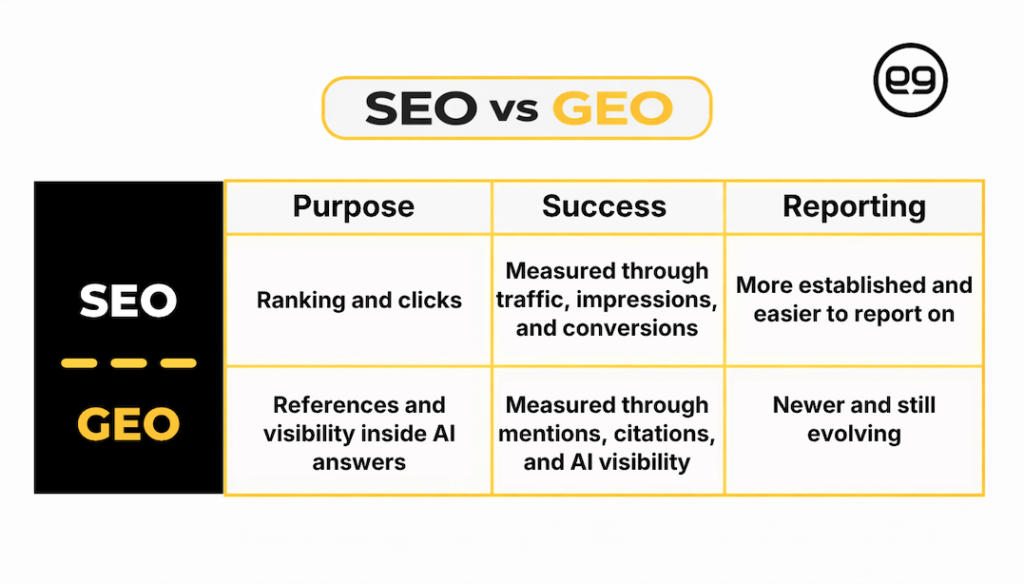
SEO is focused on ranking pages in traditional search results. GEO is focused on getting your content pulled into AI-generated answers. They overlap, but they are not interchangeable.
Here is the clearest way to think about SEO vs GEO conversations:
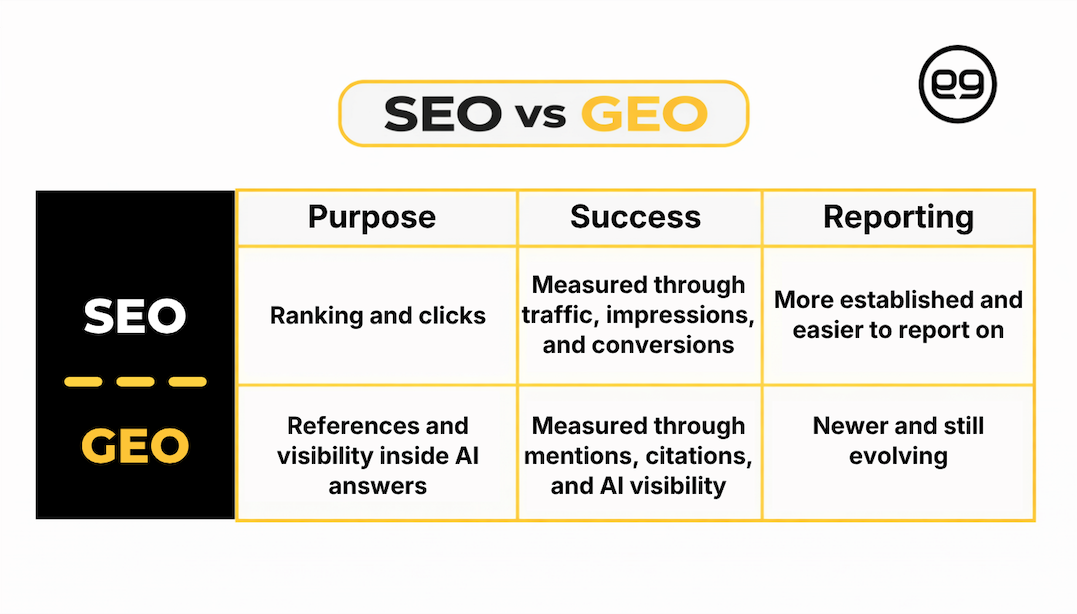
That last point matters because AI results can reduce the traffic value of strong rankings. A business can still rank well and still lose some clicks if the answer appears first.
That is the real difference in SEO vs GEO. SEO helps you win the position. GEO helps you win presence inside the answer.
GEO & SEO: Stronger Answers. More consistency. Less Fluff
The rules got trickier, but strong content still walks in like it owns the room.
Here is the part that should calm people down a little. For all the noise around AI search, a lot of the habits that make a website strong in traditional search still matter in generative search too. The fundamentals did not get thrown out. They just have a second audience now.
Both GEO and SEO strategies reward content that is easy to understand. Search engines and AI tools both perform better when a page is well organized, clearly written, and built around a real topic instead of a pile of vague buzzwords. If your site reads like a long meeting nobody wanted to attend, neither system is going to reward it.
GEO SEO overlap is real. Both rely on a few of the same core strengths:
- Clear headings and logical structure
- Useful content that actually answers questions
- Strong topical coverage, not thin filler
- Consistent business information and brand signals
- Solid technical SEO that makes pages accessible and crawlable
AI search may look new on the surface, but it still favors content that is specific, readable, and trustworthy. A well-built page gives Google something to rank and gives AI systems something to understand.
GEO Impacts SEO: Ranking High Will Not Save Bad Content
You can still rank. You can still show up. But now the answer may greet the customer at the curb before they ever step inside.
This is where SEO vs GEO vs AEO (answer engine optimization) gets more practical. GEO does not replace SEO, but it does change what SEO gets to keep. Strong rankings still matter. Traditional optimization still matters. What changes is what happens after your content appears in search.
Here’s the shift:
- Base discoverability: Strong SEO still gives your business the foundation for getting found. GEO does not remove the need for crawlable, indexable, well-optimized pages.
- Post-ranking visibility: GEO changes what visibility looks like after you rank. A result can still be seen without earning a click if AI has already summarized the answer.
- Content structure: Structure matters more than ever. Clear definitions, concise answer sections, strong formatting, and useful FAQs help content perform in both traditional and AI-driven search.
- Zero-click urgency: Zero-click behavior makes this more important. Since 58.5% of U.S. searches already end without a click, businesses need to stop treating traffic as the only measure of visibility.
The real change in GEO SEO is that your content has to do two jobs now. It has to rank well enough to be found and be useful enough to reference. In the old model, ranking and traffic were tightly connected. Now a page can earn visibility without earning the visit, because AI may answer the question before the click ever happens. When you are answering people’s questions, that still gives you the spotlight and helps earn their trust.
We’ve adapted this strategy within e9digital. Search presentation is changing, and businesses need content that can perform across both the traditional results page and the AI-generated answer layer.
What Now: Content for the Best of Both Search Worlds
This is the moment to stop being sloppy and start being useful.
Most businesses do not need a giant “future of AI search” presentation by tomorrow morning. They need a better version of the work they probably should have been doing already, like cleaner pages and better structure.
That is the real takeaway from GEO vs SEO right now. If you want visibility in both traditional and AI-assisted search, the smartest move is to tighten the fundamentals and make your content easier to trust and easier to extract.
Here is where businesses should focus first:
- Technical SEO: Keep the basics strong with solid site health, internal linking, page quality, and local optimization.
- Direct answers: Write content that answers real questions clearly instead of taking six paragraphs to get to the point.
- Clear structure: Use H2s, H3s, bullets, comparison sections, and FAQs that humans and machines can both follow easily.
- Brand consistency: Make sure your website, Google Business Profile, and citation sources all tell the same story about who you are and what you do.
- Visibility tracking: Measure more than traffic by watching branded search growth, click behavior, and other signs that visibility is shifting.
If your content is vague, thin, or disorganized, AI search will expose that fast. If your site is clear, credible, and structured well, both traditional search engines and generative systems have a better chance of using it. That’s why our team at e9digital works with small businesses to build a visibility system that works in tandem with SEO and GEO.
FAQ: Getting Started With GEO
How does GEO shift the power of SEO?
“If your content still reads like a brochure from 1998, GEO is going to leave you on the curb.” — Conrad Strabone, Managing Partner & President | e9digital
GEO does not replace SEO, but it does change how much value ranking alone can deliver.
A page can still rank well in search, but if an AI tool summarizes the answer before the user clicks, that page may get less traffic than it would have in the past. That means content now needs to do two things well: rank in traditional search and be clear enough to get pulled into AI-generated answers.
That is why SEO vs GEO is becoming a more important conversation. Visibility is no longer just about where you rank. It is also about whether your content gets used in the answer layer.
Is GEO the new SEO?
No. GEO is not the new SEO.
SEO is still the foundation for search visibility. Your site still needs to be crawlable, well-structured, useful, and relevant if you want to show up in search results. GEO adds another layer on top of that by helping your content perform better in AI-driven search experiences.
The better way to think about GEO SEO is this: SEO helps your site get found, and GEO helps your content get featured.
How should small businesses get started with GEO?
Small businesses do not need to reinvent their entire marketing strategy to get started with GEO. They need to improve the pages they already want people to find.
The best place to start is with a few practical moves:
- Make content clearer and easier to scan
- Answer common customer questions directly
- Use strong headings and structured sections
- Strengthen credibility with accurate, useful information
- Keep business details consistent across your website and local listings
The businesses that explain things well, organize information clearly, and build trust are in a better position to show up in both traditional and AI-assisted search.
Can small businesses do GEO without breaking their budget?
Yes. Most small businesses do not need a giant content machine. They need fewer pages that sit there looking pretty and more pages that do a real job.
That usually means improving what is already on the site, like:
- Service page copy: tighten the message so people understand what you do faster
- FAQ content: answer real customer questions directly instead of dancing around them
- Headings and structure: make the page easier to scan for humans and easier to interpret for AI
- Existing content quality: clean up vague language, filler, and anything that buries the point
Small businesses usually do not have a content-volume problem. They have a clarity problem. A handful of strong, well-structured pages can do more than a warehouse full of filler.
How do you measure GEO if it is not just about traffic?
This is where people need to stop staring at traffic like it is the only scoreboard in the stadium.
GEO does not always show up the way traditional SEO does, so you need to look at other signals too, including:
- Branded search growth: more people searching for your business by name
- AI citations or mentions: your brand or content showing up in generated answers
- Referral traffic from AI tools: visits coming from platforms like ChatGPT or Perplexity
- Assisted conversions: leads or sales influenced by earlier visibility, even if the first touch did not come through search traffic
- Engagement trends: stronger time on page, better page interaction, or more action on pages built to answer key questions
Not every win walks through the front door with a name tag on. Some of it shows up as stronger recognition, better visibility, and more qualified interest before the visit ever happens.
GEO Is New. Visibility Is Not.
Search changed its clothes, but the job is still the job. You need to be seen, understood, and chosen.
This is the part where a lot of businesses get themselves twisted up. They start debating whether SEO matters more than GEO, or whether AI search changes everything, or whether they should blow up the whole strategy and start over because a new acronym showed up in the group chat.
That is usually the wrong move.
The smart move is simpler. Build a website and content system that can perform in both environments. That means better structure, better clarity, stronger answers, and a site that actually supports the way people search now.
The brands that succeed here are not the ones chasing every trend like a tourist chasing a yellow cab in Midtown. They are the ones building something solid enough to hold up when the platform changes.
For most companies, that means:
- Keeping SEO fundamentals strong
- Creating content that answers real questions
- Structuring pages so humans and machines can both understand them
- Watching how AI changes visibility, not just traffic
- Treating search as a full ecosystem, not a single ranking report
At e9digital, this is not some abstract future of search debate. It is the work. We build websites, content, and visibility strategies for small businesses that need to perform now, even as the rules keep shifting.
If your business needs a search strategy that works in both traditional and AI-driven environments, e9digital can help you build one that is clear, credible, and ready for where search is headed next.
The post GEO vs SEO: The Differences Explained appeared first on e9digital.