The Right Way to Look at Website Marketing Costs
Maybe you can relate to this dialogue we constantly have with potential clients.
Client: “Our budget is $15,000.”
They think they are being responsible.
We have to give them the hard truth.
Agency: “That’s the wrong place to start.”
In reality, your competitors don’t care what your budget is. The only thing that matters is what it costs to win.
Website Budget: The Formula 1 Analogy
Imagine showing up to a Formula 1 race in a family sedan.
You might have an excellent driver, fantastic work ethic, and even be willing to put in more effort than everyone else on the track.
But none of that changes the reality of the competition, where a Maserati 250F will leave you in the dust.
Formula 1 isn’t won because one driver wants it more. It’s won through flawless execution. Every team invests millions into developing faster cars, better data, and smarter strategies because that’s what it takes to compete at the highest level.
Business works the same way.
How This Applies to Your Digital Marketing Budget
Your competitors are constantly improving their websites, refining their messaging, investing in SEO, and creating better customer experiences because 46% of consumers judge a company’s credibility based primarily on its website’s design and appearance.
Every investment they make raises the standard customers expect and increases the level of competition in your market.
That’s why asking, “What’s our marketing budget?” is often the wrong question.
A Formula 1 team doesn’t decide its budget first and hope it’s enough to win. It determines what it takes to be competitive, then invests accordingly.
Businesses should approach marketing the same way.
Your budget doesn’t determine what it takes to compete.
The market already has. Your competitors are simply responding to it.
The only question is whether you’re keeping pace or watching the race from behind.
The Biggest Marketing Mistake Businesses Make
One of the most common mistakes businesses make is starting every marketing conversation with the same sentence: “Here’s our budget.”
Imagine calling an architect and saying, “I have $500,000. Design me a building.” The architect’s first question wouldn’t be about the money. It would be, “What are you trying to build?” A warehouse, an office building, and a luxury home all have different requirements and different costs.
Marketing planning is the same.
Before anyone can recommend a website, SEO campaign, advertising strategy, or branding initiative, they first need to understand what success looks like.
Are you trying to:
- Dominate Google search results in your market?
- Generate more qualified leads?
- Enter a new geographic market?
- Launch a new product or service?
- Increase revenue from existing customers?
- Recruit better employees?
- Improve brand awareness?
- Differentiate yourself from larger competitors?
Each objective requires a different strategy, resources, and level of investment.
If you start with an arbitrary budget, you often end up buying what fits the number instead of what solves the problem. And that results in disaster: B2B organizations lose about 13% of potential sales due to poor buying experiences.
Your Competitors Are Setting the Price
“Your budget doesn’t matter to your competitors. The market sets the price of admission, and you either invest enough to compete or you sit in the stands watching someone else win.” — Conrad Strabone, Managing Partner & President | e9digital
On average, a marketing budget is about 8% of a company’s revenue. But that can vary depending on what your competitors are spending to compete in your market.
Every day, they’re making decisions about where to invest their marketing dollars. Some are improving their websites. Others are investing in SEO to rank higher in search results.
Each of those investments helps them become more visible, credible, and competitive.
Over time, those individual decisions become the ticket to play for everyone else.
Imagine opening a coffee shop in a town where every competitor offers online ordering, loyalty rewards, mobile payments, and same-day promotions. You can choose not to offer those things, but that doesn’t change what customers have come to expect. Their expectations have already been shaped by the market.
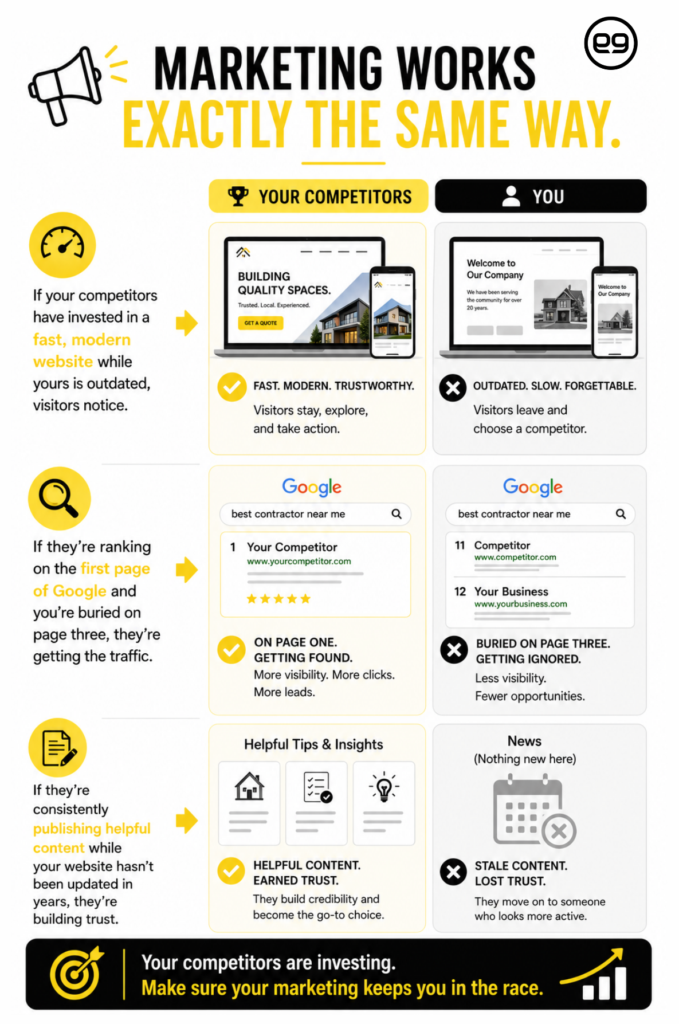
Marketing works exactly the same way.
- If your competitors have invested in a fast, modern website while yours is outdated, visitors notice.
- If they’re ranking on the first page of Google and you’re buried on page three, they’re getting the traffic.
- If they’re consistently publishing helpful content while your website hasn’t been updated in years, they’re building trust.
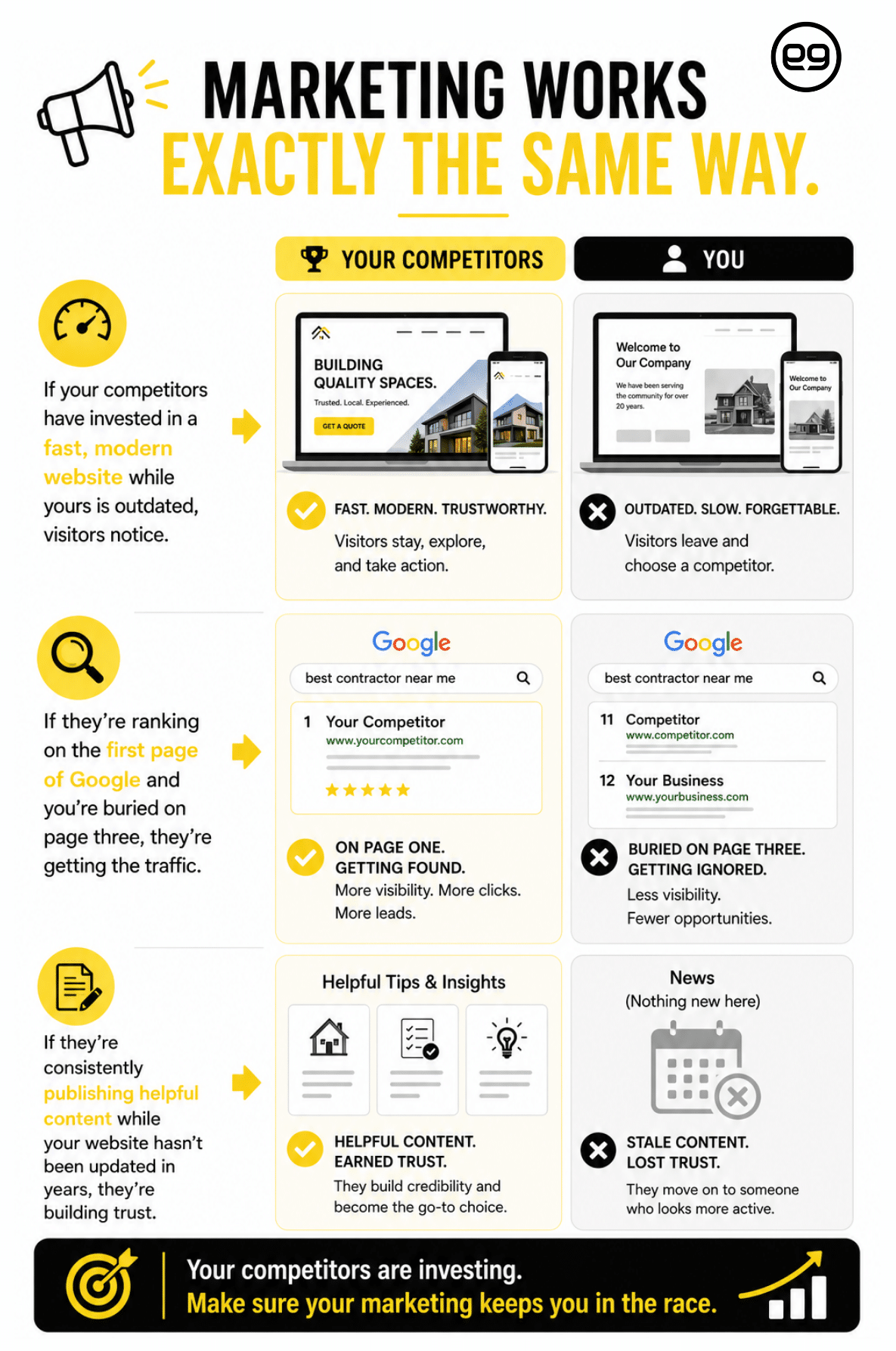
None of those advantages happened by accident. They happened because those businesses chose to invest in capabilities that help them win.
Digital Marketing Strategy Before Budget
“Marketing is not a lottery ticket. If spending $500 could reliably make $100,000, every one of your competitors would already be doing it.” — Conrad Strabone, Managing Partner & President | e9digital
The best marketing conversations begin with questions.
A good agency isn’t trying to figure out how much money it can charge you. It’s trying to understand what success looks like and what it will realistically take to achieve it.
That means the agency should ask questions such as:
- What are your business goals? Your goals determine the strategy, whether you want to generate more leads, increase revenue, launch a new service, recruit employees, or expand into new markets.
- Who are your competitors? Your competitive landscape helps determine how much investment is needed to stand out and win attention.
- What market are you operating in? Some industries are more competitive than others, so the right investment depends on how difficult it is to earn visibility and trust in your space.
- What is success worth to your business? Customer value matters because a $50,000 client should shape your marketing decisions differently than a $50 sale.
- What happens if nothing changes? The cost of doing nothing can be significant if competitors keep improving while you lose customers and revenue.
Only after these questions have been answered does it make sense to discuss budgets.
Because the right investment isn’t determined by an arbitrary number on a spreadsheet.
It’s determined by your goals, your competition, your market, and the opportunities you’re trying to capture.
Questions Businesses Should Ask About Website Design Instead
The next time you’re planning a website redesign or marketing initiative, resist the urge to begin with the question:
“How much does the website redesign cost?”
Price matters, but it shouldn’t be the starting point.
Instead, ask questions that help define the problem, measure the opportunity, and determine what success is worth. Those answers will naturally guide the right level of website investment.
- What does success look like? Your budget should be tied to a clear goal, whether that means more qualified leads, higher revenue, stronger brand awareness, better search rankings, or improved marketing ROI.
- What are my competitors doing? Your competitive landscape helps determine how much you need to invest in your website, SEO, advertising, content, and customer experience to compete effectively.
- What’s my opportunity worth? The value of the opportunity matters because winning one high-value client may justify a very different investment than earning many smaller transactions.
- What’s a new customer worth? Customer lifetime value helps you see marketing as an investment, not just an expense.
- What’s my ROI target? A clear return goal, such as more leads, higher sales, or expansion into a new market, makes it easier to measure whether your marketing is working.
- What’s the cost of doing nothing? Standing still has a cost if competitors continue gaining visibility, strengthening their brands, attracting customers, and increasing market share.
When businesses start asking these questions, they start searching for the smartest investment instead of the cheapest solution. That’s the difference between maintaining the status quo and creating meaningful, long-term growth.
Invest With Purpose With Help From e9digital
“The question isn’t, ‘How little can I spend?’ The question is, ‘What do I need to invest to get the outcome I actually want?’ That’s a very different conversation.” — Conrad Strabone, Managing Partner & President | e9digital
At e9digital, we don’t begin with numbers.
We begin with objectives.
Before recommending websites, SEO, paid advertising, branding, or marketing strategy, we first understand your business, competitors, customers, and goals.
Only then do we build a plan that’s a fair offer designed to generate measurable results, not simply fit inside an arbitrary budget or overcharge you for services.
Learn more about our website design and development, branding, and marketing services and schedule a call with our team today.
Budget FAQs
What’s the typical marketing budget?
There isn’t a universal number. The right investment depends on your goals, competitors, industry, and growth objectives.
Should I set a marketing budget first?
It’s generally more effective to define your business goals and strategy first, then determine the investment needed to achieve them.
How do I know if my marketing budget is too low?
If your competitors consistently outperform you in visibility, lead generation, and customer acquisition, your current investment—or how it’s allocated—may not be enough to compete.
What’s the difference between a marketing budget and a marketing investment?
A budget focuses on limiting costs, while an investment focuses on generating measurable business returns.
Why do marketing costs vary so much?
Marketing costs depend on your competitive landscape, target audience, business goals, service mix, and the level of expertise required.
Should I choose the lowest-priced marketing proposal?
Not necessarily. The lowest-cost option may exclude strategy, research, optimization, or long-term support that contribute to stronger business outcomes.
The post Your Competitors Already Decided Your Marketing Budget appeared first on e9digital.