Your Website Might Not Need a Redesign
Websites usually need a redesign every five to ten years. However, a lot of websites don’t need a total overhaul. They need a better story.
Many websites begin with the wrong priorities: “What colors should we use?”
“What layout do we like?”
“What template should we start with?”
Those decisions matter, but they’re not where great websites begin. The best-performing websites start with understanding the customer, the problem they’re trying to solve, and why someone should trust your business over everyone else.
That’s because before visitors buy your services… they buy your story.
Signs Your Website Is Telling the Wrong Story
Most websites don’t fail because they’re ugly. They fail because they’re forgettable. Storytelling helps people process, retain, and emotionally connect with information far better than facts presented in isolation.1 Stories make ideas meaningful—and memorable.
This is where most companies go wrong with their website storytelling:
- The homepage talks mostly about your company: Visitors care about solving their problems first.
- Your competitors could swap in their logo and nothing would change: Generic messaging makes differentiation impossible.
- You list services instead of telling a story: Features inform. Stories persuade.
- The design receives more attention than the content: Visitors remember what they understood, not what looked pretty.
- Visitors don’t know what to do next: Weak calls-to-action create hesitation.
- Your website lacks proof: Claims without evidence rarely build trust.
- Services are listed but not explained: Customers want outcomes, not feature lists.
- Every page feels disconnected: Without a consistent narrative, the website feels overwhelming instead of one cohesive experience.
The result is a website that looks professional, but doesn’t perform.
Design-First vs. Story-First Websites
“Your client is already asking, ‘Am I in the right place?’ A great website answers that question before they have to think about it.” — Conrad Strabone, Managing Partner & President | e9digital
Design-first websites start with templates rather than business goals. They often copy competitors, so they’re not differentiating you from the competition. Generic messaging doesn’t build trust, which is one of the most important drivers of purchasing decisions.2
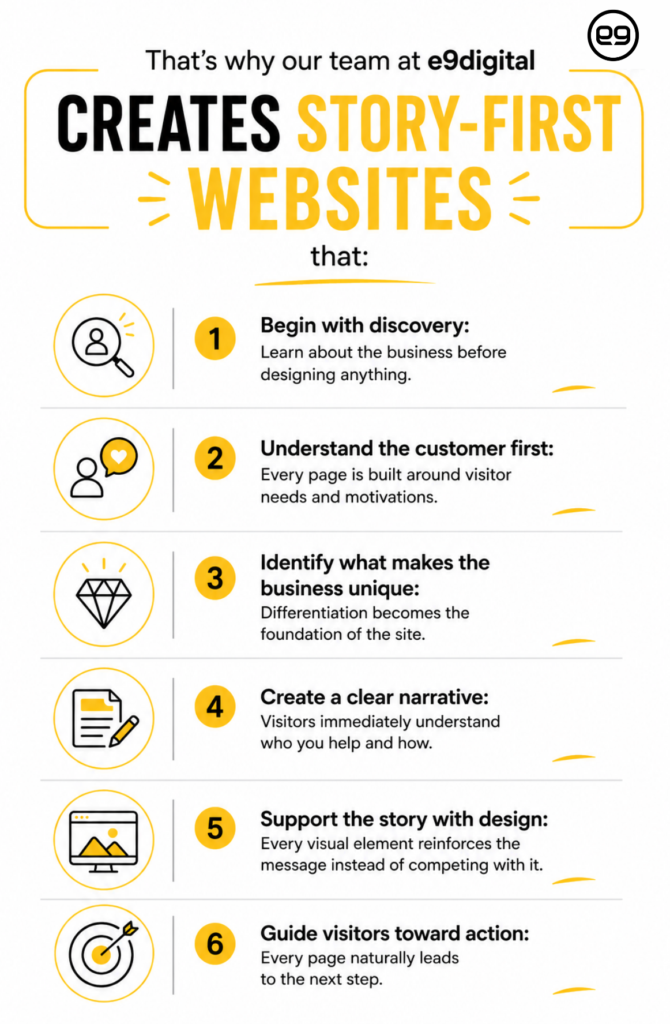
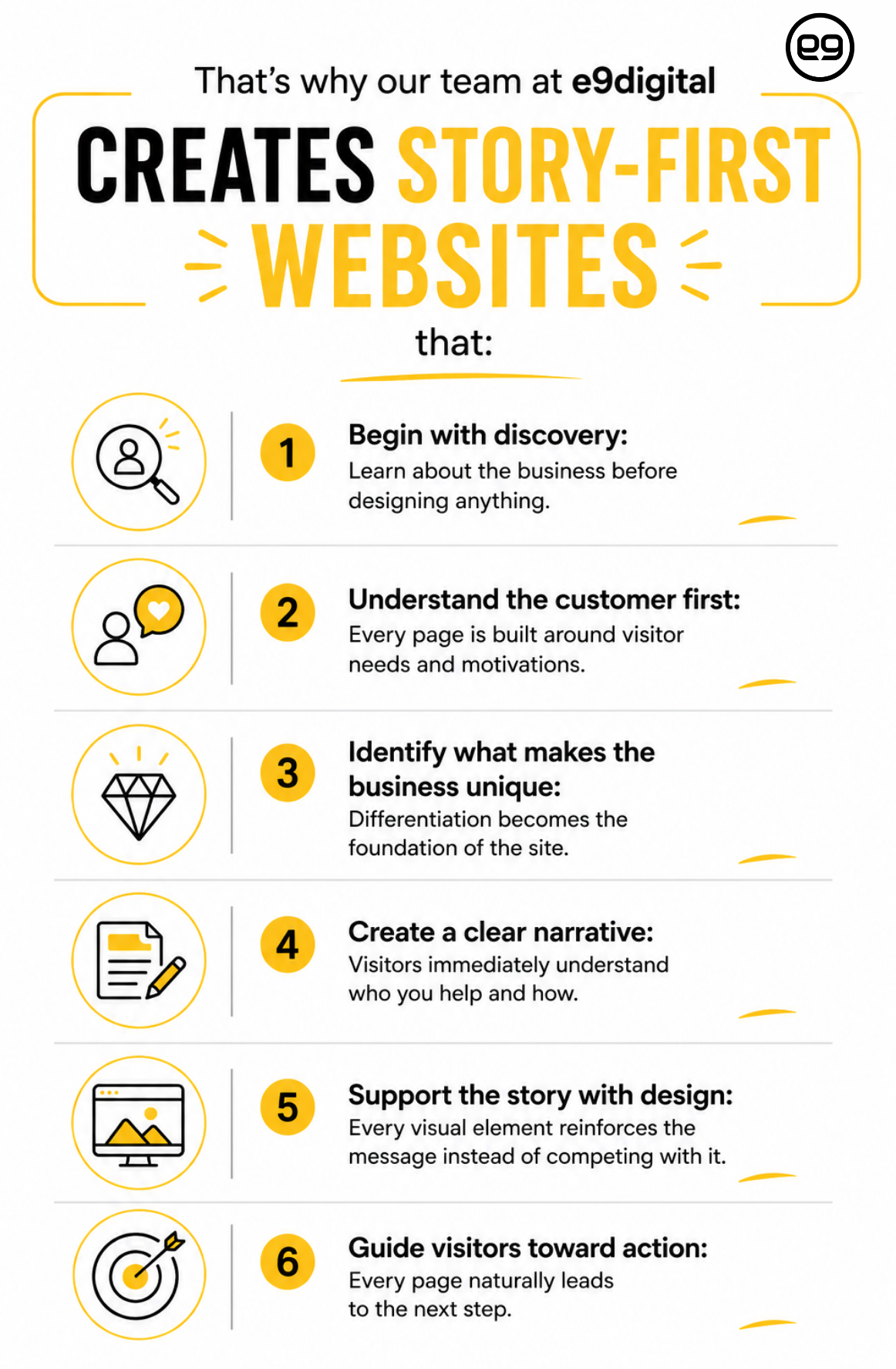
That’s why our team at e9digital creates story-first websites that:
- Begin with discovery: Learn about the business before designing anything.
- Understand the customer first: Every page is built around visitor needs and motivations.
- Identify what makes the business unique: Differentiation becomes the foundation of the site.
- Create a clear narrative: Visitors immediately understand who you help and how.
- Support the story with design: Every visual element reinforces the message instead of competing with it.
- Guide visitors toward action: Every page naturally leads to the next step.
Think about someone who is looking to purchase clean energy. They aren’t going to search for “nuclear power plants.” They will search for “clean energy,” so nuclear power plant companies need to lead with that phrasing if they want to get people to find their website.
5 Key Parts of a Story-First Website
A story-first website helps visitors quickly understand who you serve, what problems you solve, and why they should trust you. These five elements work together to turn website messaging into a clear, persuasive experience that guides people toward action.
1. The Customer Is the Hero
Visitors don’t arrive at a professional services website thinking: “Tell me about your company.”
They arrive thinking: “I have a problem.”
Your website copywriting and imagery should answer:
- Do you understand my situation? Show empathy before expertise.
- Can I trust you? Build confidence with proof and credibility.
- Have you solved this before? Demonstrate experience through stories and results.
- What happens next? Remove uncertainty by explaining the process clearly.
The business isn’t the hero; it’s the guide to solve the hero’s problems.
2. Buyers Don’t Buy Services
People think they’re buying legal, accounting, or consulting services, but in reality, they’re buying something much deeper.
They’re buying:
- Confidence: They want reassurance they’re making the right decision.
- Reduced risk: They want someone who minimizes uncertainty.
- Expertise: They need someone who knows how to solve their problem.
- Peace of mind: They want to stop worrying.
- A better future: They’re investing in an outcome, not simply a service.
Professional services aren’t transactional. They’re emotional, so your website should reflect that.
3. Every Page Should Tell Part of the Story
“The goal is not to tell people everything you know. It is to say the right things clearly enough that they understand your value and want to take the next step.” — Conrad Strabone, Managing Partner & President | e9digital
A website isn’t one story. It’s dozens of smaller stories working together. Your pages should clarify value immediately, helping visitors understand what you do and who you help within seconds.
When thinking about pages, the following all matter for business storytelling:
| Navigation
Reduces friction: Visitors should instinctively know where to go next. |
Calls-to-Action
Move the story forward: It’s an invitation to take the next logical step. |
| Content
Answer questions: Every paragraph should reduce uncertainty and build confidence.3 |
SEO
Bring the right audience into the story: Connecting the right people with the right solution. |
4. Proof Helps People Trust You
Many businesses treat proof as an afterthought.
It should be woven throughout the website.
Use:
- Testimonials: Let customers validate your claims.
- Case studies: Show measurable business outcomes.
- Awards and certifications: Reinforce expertise.
- Statistics: Add credibility to important claims.
- Client logos: Demonstrate experience with recognizable organizations.
- Years in business: Show consistency and longevity.
- Team experience: Help visitors trust the people behind the business.
- Product visuals: Show what you’re selling through product demos, walkthroughs, etc.
Stories build emotion. Proof shows people that you can practice what you preach.
You need both.
5. Design Supports the Story
Beautiful design matters. But only when it supports the message.
Think of when you picked up a book because it had a great cover, but then the story was boring. You were tricked by the design and then disappointed by the overall results.
Design amplifies strategy.
7 Questions Every Business Should Ask Before Building a Website
Instead of asking your potential website design agency about fonts and layouts, ask questions that define your story for maximum website conversion optimization. This helps elevate the creative process and lets your design team do their best work.
1. Who Is Our Ideal Customer?
Different audiences have different problems, priorities, and motivations. The clearer you define your customer, the easier it becomes to create messaging that feels relevant and personal.
2. What Problem Are We Solving?
People don’t visit your website because they’re curious about your company. They visit because they’re looking for answers. Make the problem immediately recognizable and position your business as the guide who can solve it.
3. Why Should Someone Choose Us Instead of a Competitor?
Every company claims to provide great service. Dig deeper. What unique experience, expertise, process, or philosophy truly separates your business from everyone else?
4. What Does Success Look Like for the Customer?
Customers aren’t buying your process—they’re buying the outcome. Paint a clear picture of what life looks like after you’ve solved their problem.
5. What Proof Can We Provide?
Don’t simply tell visitors you’re trustworthy. Show them. Reviews, testimonials, case studies, measurable results, certifications, and client stories all reinforce your credibility.
6. What Action Should Visitors Take Next?
Every page should guide visitors toward one logical next step. Whether that’s scheduling a consultation, requesting a proposal, downloading a guide, or making a phone call, the path should feel obvious.
7. Does Every Page Reinforce the Same Story?
The homepage, About page, service pages, blog, and contact page should all support one consistent narrative. If every page tells a different story, visitors leave confused instead of confident.
Great Websites Don’t Start With Templates
They start with discovery.
At e9digital, we believe every successful website begins with understanding the business behind it. Before choosing colors, layouts, or technology, we uncover your story, identify your competitive advantage, and build a website that helps customers see why you’re the right choice.
Because websites aren’t built to win design awards.
They’re built to win trust.
Website Storytelling FAQs
Why is storytelling important in website design?
Storytelling helps businesses connect with visitors, explain their value more clearly, build trust, and guide prospects toward taking action.
Should messaging come before website design?
Yes. Strong messaging gives design a purpose. Once the story is clear, every visual element can reinforce that message instead of competing with it.
What is a story-driven website?
A story-driven website focuses on the customer’s journey and website user experience, positioning the business as the trusted guide that helps visitors solve problems and achieve desired outcomes.
How can I tell if my website tells a good story?
Visitors should quickly understand who you help, what problems you solve, why you’re different, what proof supports your claims, and what action to take next.
Why do so many websites fail to generate leads?
Many websites focus on appearance instead of strategy. Without clear messaging, proof, differentiation, and a compelling narrative, even beautiful websites struggle to convert visitors into customers.
Resources
1. https://greatergood.berkeley.edu/article/item/why_your_brain_loves_good_storytelling
2. https://www.edelman.com/trust/trust-barometer
3. https://contentmarketinginstitute.com/articles/
The post The Secret Behind High Converting Websites appeared first on e9digital.