Small Business. Big, Big, BIG Digital Opportunity.
“You don’t need to be everywhere. You need to be where your customers are, with something useful to say when you get there.” — Conrad Strabone, Founder & Chief Happiness Officer | e9digital
Running a small business means wearing a million hats. Now you are also supposed to understand Google, SEO, social media, email, paid advertising, content, AI, analytics and whatever marketing platform shows up next Tuesday? That’s an impossible task.
Here’s the good news: You don’t need to do or even understand everything. You need to do the right things together.
Digital marketing for small businesses gives companies practical ways to reach prospective customers, build visibility, compete in their markets and measure what is working. The challenge is turning all those available channels into one coherent strategy.
What Is Digital Marketing?
Digital marketing is the use of online channels and technology to connect a business with current and prospective customers.
That can include your:
- Website
- Google Business Profile
- Email newsletter
- Social media profiles
- Online advertising
- Other digital touchpoints
Each channel plays a different role in helping people discover, evaluate and choose your business. But the real opportunity comes from getting them to work together.
Effective marketing for small businesses creates a connected experience. Someone might discover your company through searching on Google, reading a blog, visiting a service page, seeing a remarketing ad and finally contacting you after receiving an email. Each interaction helps move that person closer to a decision.
Why Is Digital Marketing Important for Small Businesses?
Only 4% of consumers say they never read online reviews when researching businesses.1 Small businesses have always depended on visibility, reputation and relationships. Digital marketing does not change those fundamentals. It gives businesses new ways to build all three.
A prospective customer can discover you through touchpoints such as Google, reading your reviews, visiting your website, watching a video, joining your email list and returning after seeing another piece of content, all before ever calling you.
Your customers are already moving between channels. Your marketing needs to create a clear and consistent experience wherever they encounter your business.
The Biggest Benefits of Digital Marketing for Small Businesses
Small businesses may not have Fortune 500, Super Bowl-worthy budgets, but digital marketing offers something traditional mass advertising often could not. It offers the ability to target specific audiences, test ideas, measure responses and adjust strategy without buying an enormous media campaign.
Benefit #1: Reach Customers Where They’re Looking
Search, social media, email and online content give businesses multiple opportunities to appear throughout the customer journey.
A strong online small business marketing strategy supports each stage:
- Discovery: A prospective customer encounters your business for the first time.
- Research: They explore your website, content, reviews and other information.
- Trust: They find credible reasons to feel confident in your business.
- Decision: They choose whether to contact you, make a purchase or take another action.
- Relationship: Your business stays connected with them after that initial action.
Customers may need several useful, trustworthy encounters with your business before they are ready to act.
Benefit #2: Target More Precisely
Digital platforms can help small businesses concentrate their budgets on relevant audiences instead of paying to reach everybody.
Targeting options may include:
- Search intent: Reach people based on what they are actively searching for.
- Geography: Focus on the neighborhoods, cities or regions your business serves.
- Interests and behaviors: Connect with audiences based on their online activity.
- Demographics: Narrow campaigns using relevant audience characteristics.
- Website activity: Reconnect with people who previously visited your site.
- Customer relationships: Communicate with current customers or similar audiences.
Available targeting capabilities vary by platform. The right choice depends on your audience, offer and goals.
Benefit #3: Measure Performance
Digital marketing provides more signals for understanding how people encounter and respond to your business.
Depending on the channel and tracking setup, a company may measure the following metrics:
- Traffic and impressions
- Clicks and leads
- Calls and form submissions
- Purchase and conversion rates
- Cost per lead and customer acquisition
Digital marketing does not make everything perfectly measurable. Attribution still has limitations, especially when customers use multiple devices or encounter a business through several channels.
Still, measurement is one of the major benefits of a digital marketing strategy. Instead of relying entirely on instinct, businesses can use real performance signals to guide decisions.
Benefit #4: Start Small and Learn
A small business does not need to launch ten marketing initiatives simultaneously. A focused small business digital marketing strategy allows the company to begin with its strongest opportunities and expand based on what it learns.
The process is straightforward:
- Test: Launch a focused campaign or tactic.
- Measure: Track the results that matter to the business.
- Learn: Identify what worked and what needs to change.
- Improve: Adjust the strategy based on real performance.
- Scale: Invest more in the approaches producing the best results.
Think of it like rehearsals for a Broadway play. You would never invite your critics to a dress rehearsal. You put the work in, learn from the response, and make improvements before inviting them to previews.
Benefit #5: Build Long-Term Marketing Assets
Some marketing disappears as soon as you stop paying for it. Other investments can continue supporting your business well into the future.
Long-term digital assets can include:
- Website content and search visibility
- Email lists and educational resources
- Videos and case studies
- Customer reviews and brand recognition
The best digital marketing solutions for small businesses balance immediate lead generation with assets that become more valuable over time.
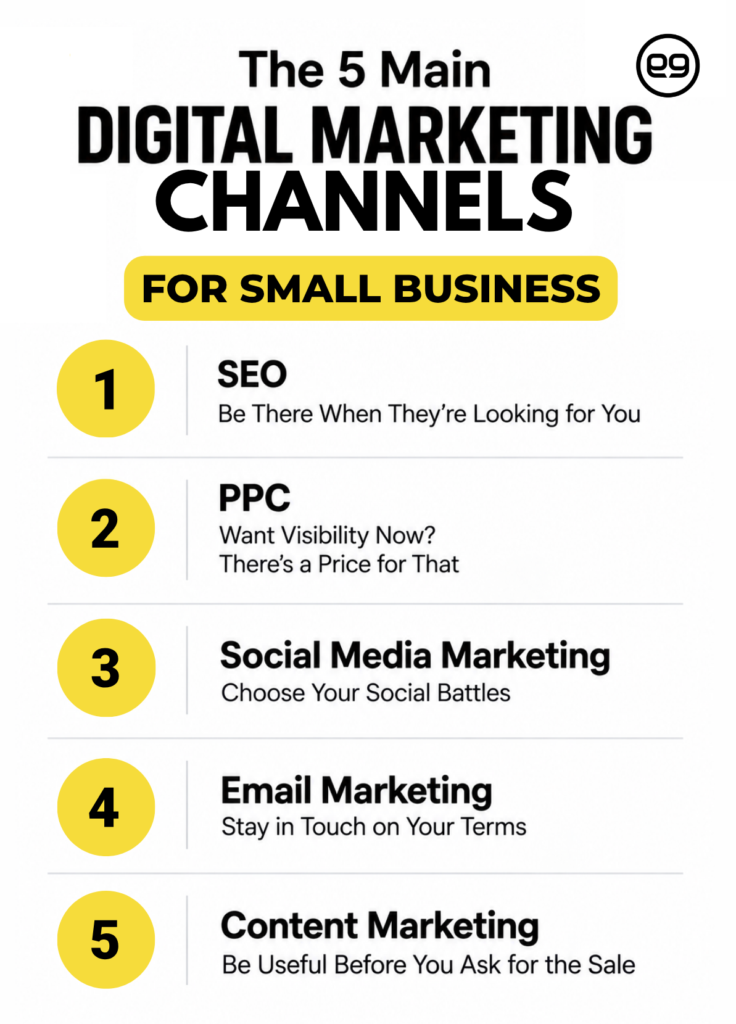
The 5 Main Digital Marketing Channels for Small Business
“Your marketing channels should work like a relay team. SEO, ads, email and content all have to move the opportunity forward without dropping it.” — Conrad Strabone, Founder & Chief Happiness Officer | e9digital
The right marketing mix depends on your business, audience, competitive environment and budget. Understanding the five primary channels will help you decide where to focus and how each one can support the others.
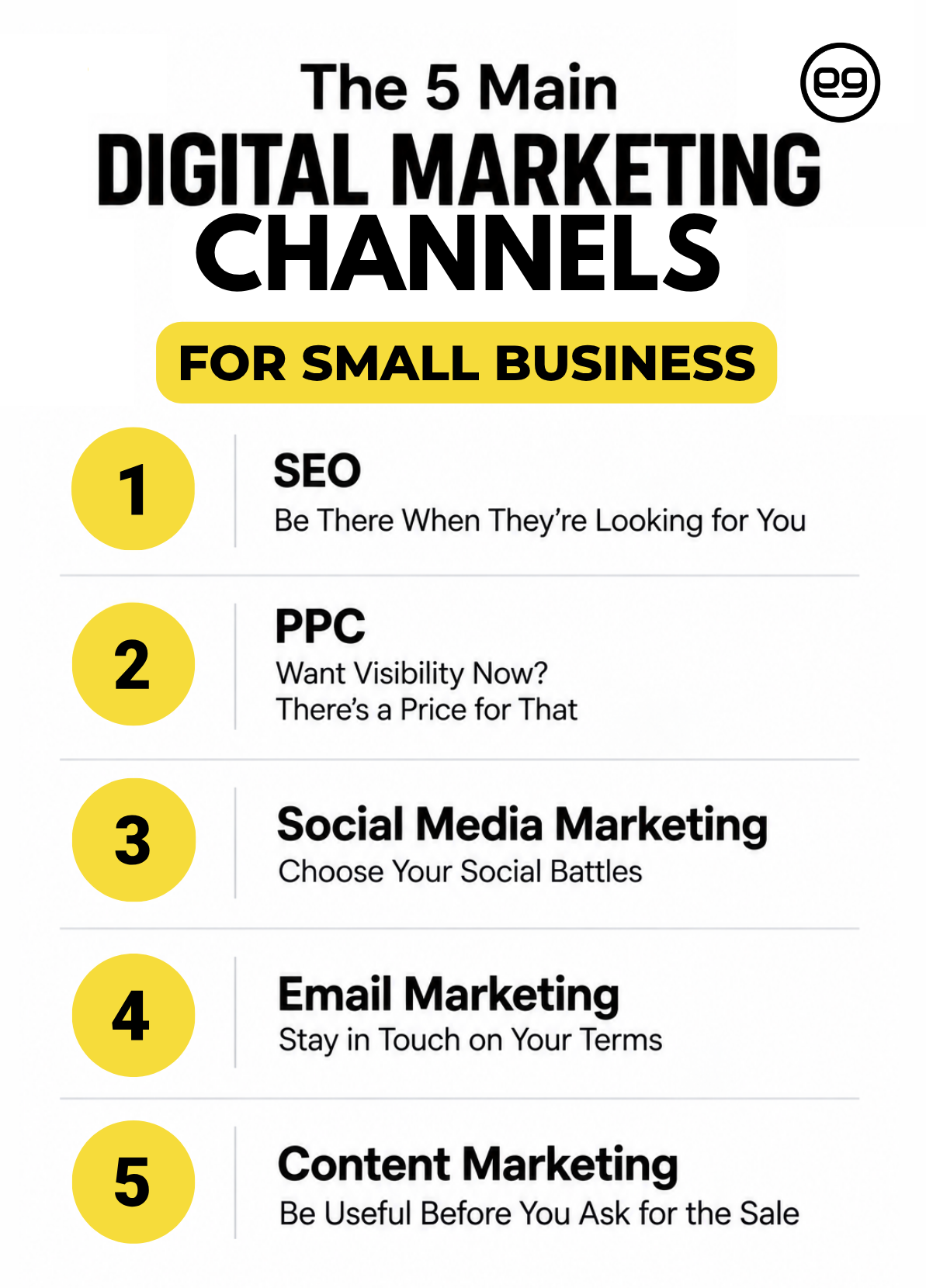
1. SEO: Be There When They’re Looking for You
SEO helps improve a website’s visibility in organic search results. For a small business, that can mean appearing when someone searches for the exact service, product or problem the company addresses.
Unlike paid advertising, businesses do not pay Google every time someone clicks an organic result. But SEO is not free. It requires an investment in strategy, website performance, content and authority.
Small-business SEO may include:
- Keyword research: Understand how real customers search.
- Search intent: Identify why someone is conducting a search.
- On-page optimization: Make important pages clear to search engines and people.
- Technical SEO: Keep the website crawlable, indexable and fast.
- Local SEO: Improve visibility in relevant geographic markets.
- Content: Build useful resources around customer questions.
- Authority: Earn credible links, mentions and recognition online.
- Mobile optimization: Give phone users a fast, readable and easy-to-navigate experience.
More than 60% of Google searches are performed on mobile devices.2 For a small business, a large percentage of prospective customers may experience the company for the first time on a phone. Internet marketing for local businesses must account for how quickly those visitors can find information, get directions, make a call or complete a form.
2. PPC: Want Visibility Now? There’s a Price for That
PPC allows businesses to pay for visibility instead of waiting to earn an organic position. It can be useful when a small business wants to target high-intent searches, enter a new market, promote a specific offering or generate traffic while a longer-term SEO program develops.
But buying traffic is not the objective. Buying the right traffic and converting it is.
PPC fundamentals include:
- Keywords: Determine which searches can trigger an ad.
- Search intent: Evaluate what the person likely wants to accomplish.
- Cost per click: Track how much each ad click costs.
- Cost per conversion: Measure how much each lead or sale costs.
- Geographic targeting: Limit ads to relevant locations.
- Negative keywords: Prevent ads from appearing for unsuitable searches.
- Landing pages: Give visitors a focused place to take action.
- Remarketing: Reconnect with people who previously interacted with the business.
- Conversion tracking: Connect campaign activity with meaningful outcomes.
The average Google Ads search cost per click is $5.26 across industries, and has an average conversion rate of 7.52%.3
Those numbers are benchmarks, not targets every small business should expect. Industry, competition, location, targeting and campaign quality can all produce dramatically different results. For example, in the legal industry, it can cost over $130.
PPC is like taking an express train. It can get you where you want to go faster, but only if you board the right one. It’s like if you accidentally get on the Express train hoping to get off at Midtown, but you might not stop until the Bronx.
3. Social Media Marketing: Choose Your Social Battles
Small businesses frequently make one of two social-media mistakes: ignoring it completely or believing they need to maintain an active presence on every platform imaginable.
The better question is: Where does your audience actually spend time, and what would they genuinely want from your business there?
Our social experts at e9digital recommend that you choose platforms based on your customers and content:
- Facebook: Community groups, local businesses, advertising and broad consumer audiences.
- Instagram: Visual businesses, lifestyle brands, restaurants, retailers, beauty companies and designers.
- LinkedIn: B2B companies, professional services, recruiting and thought leadership.
- YouTube: Education, demonstrations, expertise and searchable long-form video.
- TikTok: Short-form discovery and entertainment-focused content for appropriate audiences.
4. Email Marketing: Stay in Touch on Your Terms
Search and social media help businesses get discovered. Email gives you a way to maintain a direct relationship where you don’t have to rely on an algorithm to reconnect with customers who have already expressed interest.
Small-business email opportunities include:
- Welcome emails: Introduce new subscribers to the company and its value.
- Lead nurturing: Help interested prospects move closer to a decision.
- Newsletters: Share useful information and remain familiar to customers.
- Promotions: Highlight relevant products, services or limited-time offers.
- Follow-ups: Reconnect after an inquiry, appointment or purchase.
- Customer retention: Encourage repeat business and long-term loyalty.
- Reengagement: Bring inactive subscribers back into the conversation.
The great perk about an email list is that you’re not competing with dance videos, vacation photos and whatever the algorithm decided to serve that morning. You have a direct line to people who gave you permission to stay in touch.
Use it to send helpful messages, maintain a sensible schedule, and give every email a clear purpose.
5. Content Marketing: Be Useful Before You Ask for the Sale
Content marketing helps a business answer questions, demonstrate expertise and give prospective customers reasons to trust it.
Useful content can also support SEO, social media, email and sales. One strong resource may attract visitors through Google, supply material for several social posts, support an email campaign and help a salesperson answer a common question.
Small-business content can include:
- Blog posts and service pages
- Service pages and frequently asked questions
- Checklists, guides, and case studies
- Webinars and videos
- Podcasts
The best content begins with what customers need to understand, not what the business wants to announce.
Your website is where all five digital-marketing channels come together. SEO and PPC bring people there, social media introduces the business, email brings prospects back, and content gives them reasons to trust what they find. At e9digital, we build websites that turn separate marketing activities into one system designed to work harder.
What This Looks Like in the Real World: Accounting Firms
Let’s paint a picture of what this looks like with an industry that our team at e9digital often works with: accounting. Firms can use all five channels to reach prospective clients, demonstrate expertise and maintain long-term relationships. An effective digital marketing strategy for accounting firms may include:
- SEO: Improve technical performance, target service and location keywords, and publish useful pages.
- PPC: Increase visibility during tax season, year-end audits, service launches or geographic expansion.
- Social media marketing: Share tax reminders, financial guidance, company news and short educational videos.
- Email marketing: Send deadline reminders, quarterly newsletters, business tips and information about relevant services.
- Content marketing: Answer common questions about taxes, bookkeeping, payroll, cash flow and financial planning.
Together, these channels can bring qualified prospects to the firm’s website, build confidence in its expertise and create more opportunities for consultation requests. Track those requests, cost per lead and client acquisition to identify what is working and where the next marketing dollar may have the greatest impact.
How to Build a Small Business Digital Marketing Strategy
Posting when inspiration strikes, boosting an occasional social post and sending an email whenever business slows down may create activity. That does not mean those efforts are moving the company toward a meaningful goal.
A small business marketing strategy connects business objectives, audiences, messages, channels, budgets and performance measurement.
Here are the steps that our team at e9digital recommends:
- Set a specific goal: Choose a realistic, measurable and time-bound business result, such as generating more qualified leads or increasing online sales.
- Understand your best customers: Use interviews, sales conversations, reviews, search data and analytics to learn what your customers need, value and trust.
- Define what makes you different: Identify a specific advantage that matters to customers and that competitors cannot claim with equal credibility.
- Choose the right channels: Invest in the platforms that reach your audience, match their intent and support how your business makes money.
- Measure meaningful results: Track metrics tied to business growth, such as qualified leads, sales, conversion rates and customer acquisition costs.
- Test and improve: Refine your messaging, targeting, offers and campaigns based on performance data and changing customer behavior.
Change one meaningful variable at a time when possible. Otherwise, you may see different results without knowing what caused them.
When Should a Small Business Hire a Digital Marketing Agency?
A small business may benefit from an agency when its marketing requires more strategy, specialization or consistent execution than the internal team can provide.
Consider outside support when:
- Marketing keeps falling behind daily business priorities.
- Different vendors are working without coordination.
- The website generates traffic but few inquiries.
- Results are difficult to measure.
- The company is entering a new market.
- Internal teams lack expertise in key channels.
- Growth has stalled.
- Marketing activity is increasing without clear returns.
An agency should help clarify what deserves attention, what can wait and how each investment supports the business.
Build a Marketing System, Not a Collection of Tactics
Small businesses don’t need another marketing company telling them to do more of everything.
At e9digital, we start with something much more important: What does your business actually need?
From website strategy and SEO to paid media, content and digital marketing, e9digital helps businesses determine which pieces make sense, and then gets those pieces working together to drive sales and leads.
Build a digital marketing strategy designed around your business, your customers and your goals.
Frequently Asked Questions
What Is the Best Digital Marketing Strategy for a Small Business?
There isn’t one universal strategy. Start by defining the business goal, understanding the target customer, researching competitors and selecting the channels most capable of reaching that audience at the right point in the buying journey.
How Much Should a Small Business Spend on Digital Marketing?
There is no single correct percentage or dollar amount. Budget should reflect revenue, margins, customer value, competition, growth objectives and the economics of acquiring a new customer.
Does a Small Business Need SEO?
For businesses whose customers use search engines to find their products or services, SEO can be extremely valuable. It can help build organic visibility without paying directly for every click.
Should Small Businesses Use PPC?
PPC can be particularly useful when a business needs faster search visibility, wants to target high-intent customers or wants to test specific offers and markets. It works best when conversion tracking and landing pages are properly established.
Does Social Media Work for Small Businesses?
It can, but businesses don’t need to use every social platform. Focus on the channels where the target audience actually spends time and create content appropriate for those platforms.
Is Email Marketing Still Effective?
Yes. Email gives businesses a direct way to communicate with people who have already expressed interest. It can support customer retention, promotions, education, repeat sales and lead nurturing.
What Is Content Marketing for Small Business?
Content marketing involves creating useful information—such as articles, videos, guides, FAQs and case studies—to attract and educate prospective customers rather than relying exclusively on direct promotional messages.
Is Digital Marketing Expensive for Small Businesses?
It doesn’t have to be. Businesses can start with a focused number of channels, establish measurable goals, test performance and expand investments based on results rather than attempting to do everything at once.
How Long Does Digital Marketing Take to Work?
It depends on the channel. PPC can generate visibility quickly, while SEO and content marketing typically require more time to build momentum. Email and social performance also depend heavily on the size and quality of the existing audience.
How Do I Know If My Digital Marketing Is Working?
Start with the business goal and work backwards. Depending on that goal, meaningful measurements might include qualified leads, conversions, customer acquisition cost, sales, revenue, repeat customers and customer lifetime value—not simply traffic or followers.
Should I Hire a Digital Marketing Agency for My Small Business?
An agency may make sense when a business lacks the internal time, expertise or resources to coordinate strategy, SEO, paid media, content, analytics and website optimization. The important question isn’t simply whether to outsource—it’s whether the marketing is being managed as a connected strategy with measurable objectives.
Resources
- https://www.brightlocal.com/research/local-consumer-review-survey/
- https://support.google.com/google-ads/answer/7323900
- https://www.wordstream.com/blog/2025-google-ads-benchmarks
The post Digital Marketing for Small Business: A Guide appeared first on e9digital.