Your Marketing Can Work While You Don’t
Marketing automation didn’t start with the AI boom. Businesses have been scheduling emails, nurturing leads, and automating repetitive tasks for years. What’s changing is the intelligence behind those systems.
AI marketing automation can analyze behavior, predict what customers may do next, personalize experiences, generate and optimize content, and help marketers make decisions faster. AI can look at conditions, recognize patterns, and help determine whether there’s a better way to get where you’re going.
That can mean faster responses to customer behavior, better lead prioritization, greater personalization, and less time spent on repetitive work. The goal is to give marketers more room for strategy, judgment, and creativity.
The potential is substantial. Generative AI could contribute $2.6 trillion to $4.4 trillion annually across the business use cases it studied, with marketing and sales among four functions representing about 75% of that potential value.1
But AI isn’t an easy DIY fix. You need help from experts who know what they’re doing, or you might be the next consulting firm revealed to be using fabricated claims and fake footnotes across multiple official research reports due to improper AI use.2
What Is AI Marketing Automation?
AI marketing automation is the use of artificial intelligence and machine learning to make marketing workflows more adaptive, predictive, and personalized.
Traditional automation works from instructions. That includes things like scheduling an email for Tuesday, sending a reminder after someone abandons a cart, or adding a prospect to a workflow after a form submission. It’s useful, predictable, and largely dependent on rules marketers establish ahead of time.
AI goes further by analyzing data, identifying patterns, and using those insights to help determine what should happen next, adapting based on customer and campaign data.3
AI-powered automation can potentially:
- Predict which leads are most likely to convert.
- Personalize emails and recommendations.
- Analyze customer sentiment.
- Identify better times to contact prospects.
- Generate campaign variations.
- Evaluate performance and suggest improvements.
AI marketing automation also isn’t one technology or one piece of software. Marketing automation with AI can combine generative AI, machine learning, predictive analytics, CRM data, customer behavior, automation platforms, and content-generation tools into a broader marketing system.
How Does AI Marketing Automation Work?
“The goal is to automate the things slowing you down so your people can spend more time on the work that actually moves the business.” — Conrad Strabone, Founder & Chief Happiness Officer | e9digital
At its simplest, AI-driven marketing automation turns customer signals into useful action. Like a seasoned New York doorman, it reads the signals and knows exactly when the dry cleaning is going to apartment 4H or if a package is waiting for apartment 5J.
A prospect visits certain pages, opens an email, downloads a guide, submits a form, ignores another email, or makes a purchase. AI-powered systems can analyze those interactions and look for patterns that help determine what should happen next.
Instead of sending every prospect down the same predetermined path, the system may respond differently based on behavior, interests, purchase history, engagement, or other relevant data.
Step 1. Collect the Right Data
AI is only as useful as the information it has to work with. Before worrying about sophisticated automation, businesses need reliable, relevant data.
Potential sources include:
- Website behavior
- CRM information
- Email engagement
- Purchase history
- Form submissions
- Ad interactions
- Customer service conversations
- Previous campaign performance
Those signals provide the raw material for AI marketing keywords, audience insights, predictions, and personalization.
However, more data doesn’t automatically mean better marketing. Like getting directions in Manhattan, a lot of information is useless if half of it points the wrong way. What’s most important is that you’re using accurate, organized information that’s relevant to your clients’ needs.
Step 2. Identify Patterns
Once the data is available, machine learning marketing automation can help identify relationships across large groups of customers.
An experienced marketing team can certainly review reports and spot trends manually. The difference is scale. Machine-learning systems can analyze far more interactions and variables than someone working through dashboards one campaign at a time.4
That could reveal that certain behaviors frequently occur before a purchase, that one audience responds better at a particular time, or that engagement patterns are changing.
The marketer’s job is still important. Finding a pattern and understanding what it means for the business are two different things.
Step 3. Predict
After finding patterns, AI can use historical data to estimate what may happen next. Depending on the data and system involved, AI may estimate:
- Likelihood to purchase
- Likelihood to unsubscribe
- Lead quality
- Products of interest
- Preferred communication time
- Potential customer lifetime value
These are predictions, not guarantees. AI isn’t a crystal ball sitting in the back of a Times Square souvenir shop. Its recommendations depend on the quality of the data, the model being used, and the circumstances surrounding the customer.
Used correctly, those predictions can help marketers decide where to focus their attention and what action is most appropriate next.5
Step 4. Personalize
71% of consumers expect companies to deliver personalized interactions, while 76% become frustrated when that doesn’t happen.6
Personalization is one of the clearest opportunities for an AI marketing solution. AI can help businesses tailor communications across audiences without requiring marketers to manually create every variation.
AI-generated insights can potentially influence:
- Emails
- Offers
- Recommendations
- Landing pages
- Ad creative
- Messaging
- Customer journeys
Good personalization should make marketing more relevant, not more invasive. Businesses still need appropriate data practices, sensible guardrails, and human judgment about how personalization is used. That means using customer data responsibly, setting limits on what AI can personalize or automate, and keeping people involved when accuracy, privacy, brand voice, or sensitive customer interactions are at stake.
Step 5. Learn and Optimize
AI marketing automation can use campaign performance data to improve what happens next instead of waiting for a full post-campaign review.
For example, it can:
- Adjust email send times based on when different audience segments are most likely to engage.
- Shift ad budget toward audiences, channels, or creative variations producing stronger results.
- Change lead scores when certain behaviors prove more closely tied to conversions.
- Recommend stronger content variations based on which subject lines, messages, or offers perform best.
- Refine audience segments as new behavioral patterns emerge.
That doesn’t mean handing the keys over and catching the early 4:32 PM LIRR train. Think of AI more like having better traffic information before crossing Midtown. It can tell you where things are moving, where they’re getting backed up, and where another route might work better.
A person still needs to decide where the business is trying to go.
Where Can Businesses Use AI Marketing Automation?
Start with the work that’s eating your day. The smartest AI marketing automation strategy isn’t to automate everything because the technology makes it possible. Look for repetitive, data-heavy activities where AI can save time, improve relevance, or help your team make a better decision.
For example, AI can make customer journeys more adaptive, adjusting recommendations and nurturing based on behavior rather than forcing every prospect through the same fixed sequence.7
- Email Marketing: Generate subject-line variations, optimize send times, segment audiences, personalize content, and manage follow-ups.
- Lead Scoring: Analyze engagement and behavioral signals to help identify prospects that may deserve attention first.
- Content Marketing: Assist with research, topic discovery, outlines, variations, repurposing, and personalization. AI should accelerate expertise, not replace strategy, editing, or originality.
- Paid Advertising: Support targeting, bidding, creative variations, budget decisions, and performance analysis.
- Customer Journeys: Adjust workflows based on what customers actually do.
- Predictive Marketing: Use historical patterns to anticipate behaviors and potential opportunities.
Do More, Faster: Benefits of AI Marketing Automation
Efficiency gets most of the attention, but marketing automation with AI should improve more than your to-do list. It can help teams react faster, understand customers at scale, and put human attention where judgment is actually required.
Among organizations using AI to address labor or skills shortages, 55% were using automation tools to reduce manual or repetitive tasks.8
AI can give your team the following benefits:
- Greater Efficiency: Reduce time spent sorting data, scheduling campaigns, creating routine reports, segmenting audiences, and handling follow-ups.
- Better Personalization: Use behavior, interests, customer stage, purchase history, and predicted intent to make communications more relevant.
- Faster Decision-Making: Process large datasets without asking marketers to spend half the afternoon buried in spreadsheets.
- Improved Lead Prioritization: Help teams identify stronger buying signals and focus resources accordingly.
- Scalability: Give smaller teams the ability to manage more sophisticated campaigns without matching every increase in activity with more manual work.
- More Time For Human Creativity: Shift time toward ideas, strategy, relationships, judgment, and creative problem-solving.
How to Anticipate Customers: Predictive Marketing Automation
“The best use of AI is not replacing judgment. It’s giving good people more information, more speed, and more time to use that judgment.” — Conrad Strabone, Founder & Chief Happiness Officer | e9digital
Marketing usually works better when you’re reacting to a signal instead of guessing. Predictive marketing automation takes that a step further by using historical patterns to estimate what customers may do next.
Think of it like knowing which subway car puts you closest to the exit. You’re still making the trip, but good information can put you in a better position before you get there.
- Predictive Lead Scoring: Estimate which prospects may be more likely to convert based on past behavioral patterns.
- Purchase Propensity: Identify customers who may have a higher likelihood of buying a particular product or service.
- Churn Prediction: Look for patterns associated with customers who disengage or leave.
- Next-Best Action: Recommend which message, offer, channel, or action may be most appropriate next.
- Customer Lifetime Value: Estimate the potential long-term value of different customers or segments.
- Forecasting: Use historical information to support projections around customer behavior or campaign outcomes.
These outputs are probabilities, not promises. Predictive systems can give marketers useful direction, but the quality of the recommendation depends heavily on the quality and relevance of the underlying data. It helps if you have a team experienced in using AI to ensure the automation is implemented correctly.
AI Marketing Automation + SEO + GEO
Search is changing alongside automation. SEO still helps businesses become discoverable in traditional search engines, while GEO focuses on improving how clearly a business and its content can be understood and surfaced by generative AI systems.
AI-driven marketing automation can connect those channels more closely with customer behavior. Search intent can inform content. Content engagement can inform segmentation. CRM data can influence personalization. Those interactions can then provide more information for future campaigns.
The connection can include:
- SEO and organic search behavior
- GEO and AI-powered discovery
- Content performance
- Customer and CRM data
- Search intent
- Personalized follow-up
- Campaign automation
AI is changing how businesses manage websites, PPC campaigns, content, and search. The key is to use those tools to make marketing more relevant and efficient without relying on AI to make every decision.
For example, if someone finds your business through search, visits a service page, and downloads a guide, those actions can help shape what they see next. That might mean a more relevant follow-up email, ad, or piece of content based on what they showed interest in.
How to Use AI in Marketing Automation
The best way to start with AI in marketing automation is to pick a problem your business currently has. If your employees spend hours every week sorting leads, building reports, or sending repetitive follow-ups, start there.
Think of it like getting across Manhattan at rush hour. You don’t need every possible route. You need the one that gets you where you’re going with the least wasted time.
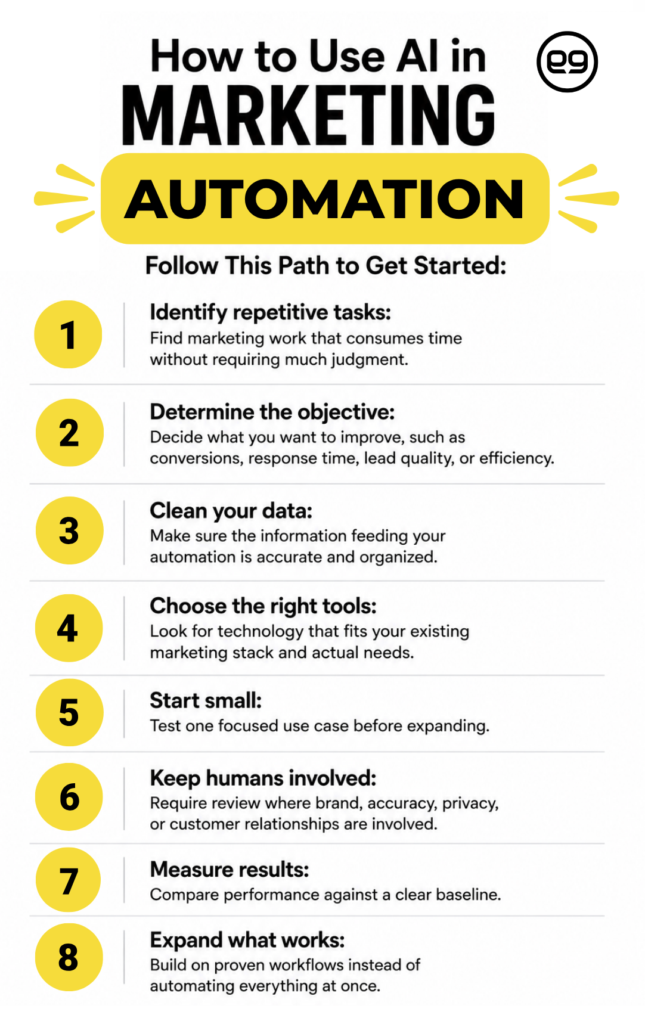
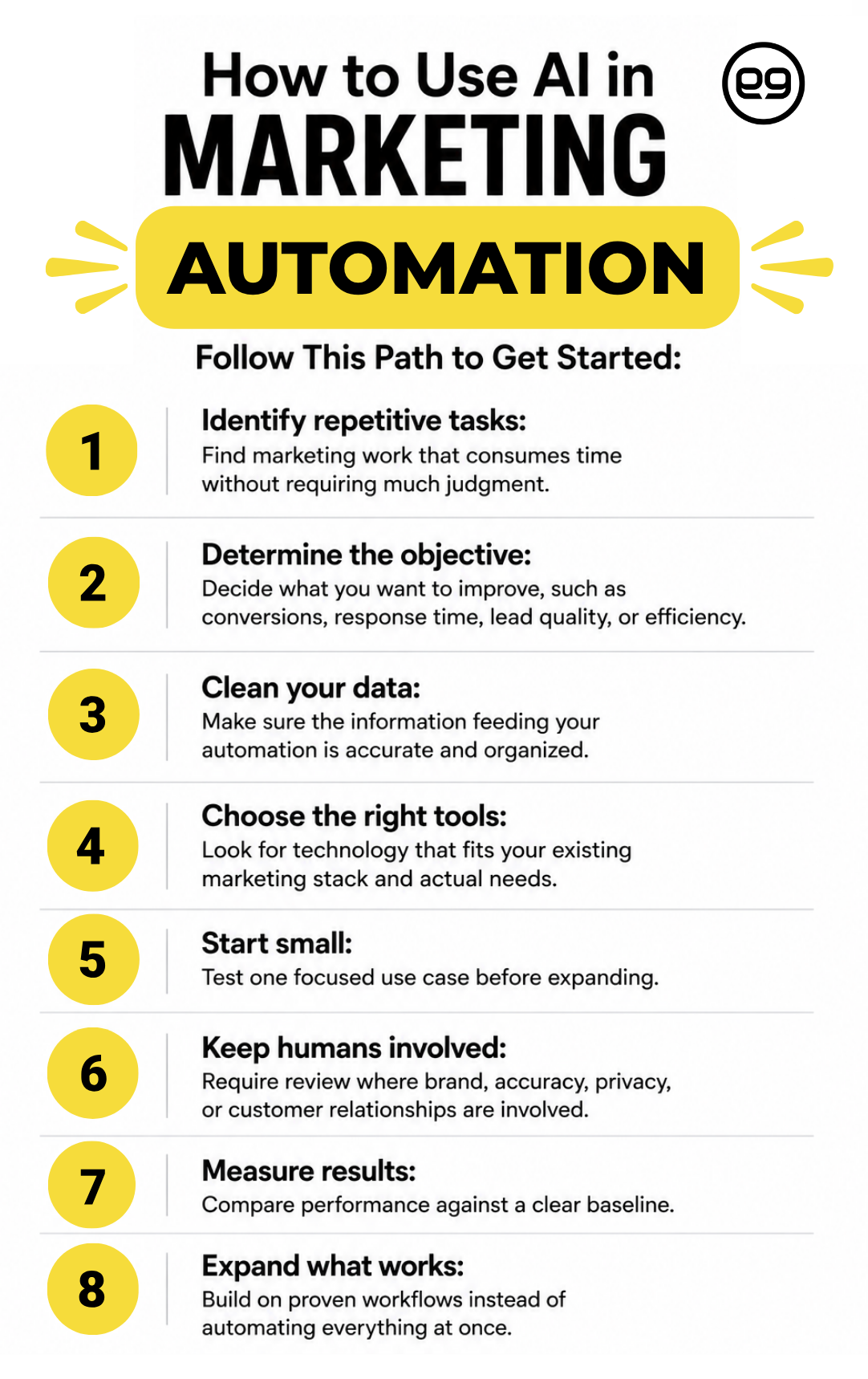
Follow this path to get started:
- Identify repetitive tasks: Find marketing work that consumes time without requiring much judgment.
- Determine the objective: Decide what you want to improve, such as conversions, response time, lead quality, or efficiency.
- Clean your data: Make sure the information feeding your automation is accurate and organized.
- Choose the right tools: Look for technology that fits your existing marketing stack and actual needs.
- Start small: Test one focused use case before expanding.
- Keep humans involved: Require review where brand, accuracy, privacy, or customer relationships are involved.
- Measure results: Compare performance against a clear baseline.
- Expand what works: Build on proven workflows instead of automating everything at once.
Measuring AI Marketing Automation ROI
If an AI marketing solution saves time but doesn’t improve your business’s return on investment (ROI), you should know that too.
The metrics you track should connect directly to the reason you introduced automation in the first place. A lead-scoring system should improve lead quality or sales efficiency. Email automation should improve engagement, conversions, or production time. Otherwise, you’re measuring activity rather than value.
Track metrics such as:
- Conversion rate: The percentage of prospects who complete the desired action.
- Cost per lead: How much marketing spend is required to generate a lead.
- Qualified leads: The number of prospects who meet your sales criteria.
- Customer acquisition cost: The total cost required to acquire a customer.
- Email engagement: Opens, clicks, replies, and other useful interaction signals.
- Revenue: Sales influenced or generated by automated campaigns.
- Retention: Whether customers continue buying or engaging.
- Time saved: Hours of manual work eliminated.
- Campaign production time: How long it takes to launch marketing activity.
Don’t Outsource Your Judgment: What AI Marketing Automation Shouldn’t Do
AI marketing automation still needs someone at the wheel. AI can write copy, analyze data, recommend actions, and execute workflows quickly. Speed becomes a problem when nobody checks whether the output is accurate, appropriate, or aligned with the brand.
There are several places where human oversight should remain non-negotiable:
- Don’t blindly publish AI-generated content: Review facts, tone, originality, and context.
- Don’t automate sensitive interactions without oversight: Complaints, major account issues, and delicate customer situations often need a person.
- Don’t sacrifice your brand voice: Efficient content that sounds like everyone else is still weak marketing.
- Don’t enter confidential data into inappropriate systems: Understand how platforms handle and store information.
- Don’t trust every AI-generated answer: AI can produce inaccurate information.
- Don’t automate for the sake of automation: Technology should solve a business problem.
AI can help you move faster through traffic. It shouldn’t decide the destination.
The Best AI Strategy Still Starts With Humans
“Every business is going to have access to the same AI tools. The advantage comes from how intelligently you use them.” — Conrad Strabone, Founder & Chief Happiness Officer | e9digital
AI can analyze enormous amounts of information, identify patterns, automate repetitive work, and help marketing teams react faster. People still bring strategy, context, empathy, creativity, and the ability to recognize when the recommendation on the screen doesn’t make sense.
At e9digital, we help businesses identify practical opportunities for AI and automation that solve real marketing problems, reduce repetitive work, and support measurable growth.
Whether you’re exploring AI for the first time or looking to connect automation with your website, content, SEO, and broader digital marketing strategy, start with what you actually want to accomplish.
You don’t need to automate every lane of the FDR to get downtown faster. You need to identify where the bottlenecks are and solve the ones slowing you down.
Ready to put AI to work for your business? Talk to e9digital about building a smarter automation strategy today.
AI Marketing Automation FAQs
What is AI marketing automation?
AI marketing automation combines traditional automation with artificial intelligence and machine learning. It can analyze data, identify patterns, predict customer behavior, personalize communications, and support automated marketing decisions.
How will AI affect email and marketing automation?
AI-driven marketing automation can make email campaigns more adaptive by helping determine who should receive a message, what content may be most relevant, and when it should be delivered.
How do you use AI in marketing automation?
Start with a specific problem. Identify the data needed, choose an appropriate tool, create a controlled workflow, maintain human oversight, measure the results, and expand only after the automation proves useful.
Will AI replace marketing automation platforms?
More likely, machine learning marketing automation and other AI capabilities will continue to become features within marketing platforms, making existing workflows more predictive, personalized, and adaptive.
Can small businesses use AI marketing automation?
Yes. Marketing automation with AI can help smaller businesses with email campaigns, lead nurturing, segmentation, content assistance, analytics, and other repetitive work without requiring a custom AI system.
Is AI marketing automation expensive?
The cost of an AI marketing solution varies considerably. Many businesses can begin with AI features already included in existing CRM, email, advertising, or automation platforms before investing in more advanced systems.
What are the risks of AI marketing automation?
Risks of AI marketing automation can include inaccurate outputs, weak or incomplete data, privacy concerns, excessive automation, inconsistent brand voice, and decisions made without sufficient human review.
What’s the difference between AI and traditional marketing automation?
Traditional automation generally executes predefined rules. AI can analyze data, identify patterns, estimate future behavior, generate content, and help workflows adapt based on new information.
Resources
- https://www.mckinsey.com/capabilities/tech-and-ai/our-insights/the-economic-potential-of-generative-ai-the-next-productivity-frontier
- https://www.elitetrader.com/et/threads/top-twenty-companies-where-ai-works-the-worst-an-ai-search.390802/
- https://www.ibm.com/think/topics/ai-marketing-automation
- https://www.atlassian.com/agile/agile-marketing/ai-marketing-automation
- https://improvado.io/blog/ai-marketing-automation
- https://www.mckinsey.com/capabilities/growth-marketing-and-sales/our-insights/the-value-of-getting-personalization-right-or-wrong-is-multiplying
- https://www.activecampaign.com/blog/ai-marketing-automation
- https://www.multivu.com/players/English/9240059-ibm-2023-global-ai-adoption-index-report/
The post AI Marketing Automation: What You Should Know appeared first on e9digital.