More Clicks Don’t Always Mean More Customers
“Traffic is only useful when it’s headed somewhere. SaaS SEO should move buyers from a question to a demo, a trial, and eventually recurring revenue.” — Conrad Strabone, Managing Partner & President | e9digital
SEO continues to be one of the highest-ROI marketing channels for long-term growth.1 But traffic alone does not pay the bills. A packed subway platform does not tell you how many riders are heading in the right direction.
Most companies measure SEO through rankings, impressions, clicks, and website traffic. Those numbers show whether your visibility is improving, but they do not show whether that attention is producing customers.
SaaS (software as a service) companies operate on recurring revenue. Success depends on attracting people who have a real problem. The website should educate them and provide the solution, giving them enough confidence to begin a trial, request a demo, or purchase a subscription.
The goal is not to bring the largest possible crowd to your website. It is to attract qualified buyers who will make a purchase or sign up for your services.
What Is SaaS SEO?
SaaS SEO is the process of optimizing a software company’s website to attract qualified organic traffic, educate prospective customers, and convert visitors into recurring subscribers.
Unlike traditional SEO campaigns that may focus primarily on generating leads, SaaS SEO supports a longer and more research-driven buying process. It helps potential customers understand their problem, evaluate possible solutions, compare products, and decide whether your platform is the right fit.
Key components of SaaS SEO include the following.
Educational Content
Educational content answers industry questions, explains complex concepts, and helps incentivize usage for potential customers. This way, they understand the problems your software solves.
Common formats include:
- Articles that answer customer questions
- Guides that explain complicated topics
- Reports that share useful research
- Tutorials that show how to complete a task
- Glossaries that define industry terminology
Google recommends creating people-first content that demonstrates expertise and satisfies user intent rather than publishing pages solely to target search rankings.2
Like a good New York tour guide, the content should help readers understand where they are, where they need to go, and the clearest route to get there.
Product Content
“Your product pages should do the selling before your salesperson joins the call. If buyers still cannot understand what the software does, the website has not done its job.” — Conrad Strabone, Managing Partner & President | e9digital
Product content helps buyers evaluate how your software works and whether it meets their needs. B2B buyers often review multiple resources while researching potential solutions, making clear and detailed product information an important part of the decision-making process.3
Use product content to answer practical questions about capabilities, workflows, costs, and compatibility. This includes:
- Feature Pages: Explain individual capabilities and show how each one solves a specific customer problem.
- Pricing Pages: Outline available plans, costs, included features, and the differences between subscription levels.
- Integration Pages: Show how your software connects with other tools and supports existing workflows.
- Industry Solutions: Explain how the platform addresses the needs, challenges, and requirements of specific industries.
- Use-Case Pages: Demonstrate how different customers or teams can use the software to complete specific tasks or achieve particular goals.
Your product pages should explain what each feature helps the customer accomplish.
Technical SEO
Software companies often manage large websites containing feature pages, integrations, documentation, support resources, blogs, and customer portals.
Strong SaaS Technical SEO helps search engines crawl, understand, and index that content efficiently. It includes improving site speed, internal linking, mobile performance, URL structure, structured data, and indexation controls (managing which pages are crawled by search engines).
Technical problems can limit visibility across hundreds or thousands of pages at once. It is like a signal problem on a major subway line. One issue can slow down the entire system, even when every individual stop is where it belongs.
A technically sound website gives your content a stronger foundation for long-term organic growth.
Conversion Optimization
Traffic has limited value if visitors do not take the next step.
Conversion optimization improves the paths that guide potential customers toward a demo, free trial, consultation, pricing request, or product signup.
Common improvements include:
- Clearer calls to action
- Shorter forms
- Stronger benefit-focused messaging
- Product screenshots or demonstrations
- Customer testimonials and case studies
- Fewer steps between interest and action
Many SaaS companies prioritize bottom-of-funnel pages because high-intent searches can produce stronger conversion opportunities than broad informational traffic.4
Every important page should provide a logical action based on the visitor’s stage of research.
3 Reasons Why SaaS SEO Is Different
Traditional SEO principles still apply to software companies. Websites need useful content, strong technical foundations, relevant keywords, and trusted links.
The difference is how those elements support the sale.
Buying software can resemble navigating the New York City subway for the first time. The destination may be clear, but the buyer still has to compare routes, understand the stops, and make sure they are boarding the right train. Effective SEO for SaaS companies provides the information needed at each decision point.
SaaS companies also face several challenges that many local businesses and ecommerce brands do not:
- Longer and more complicated sales processes
- Revenue generated over the lifetime of a subscription
- Buyers who complete extensive independent research
Your SEO plan must account for the entire buying process rather than concentrating only on the initial search.
1. Longer Buying Cycles
Buying a software subscription is rarely as simple as choosing a product, entering a credit card number, and checking out.
A prospect may spend weeks researching the category, comparing providers, reading reviews, attending demos, testing platforms, and building internal support. Enterprise purchases may also require approval from department leaders, finance teams, IT professionals, security specialists, or procurement.
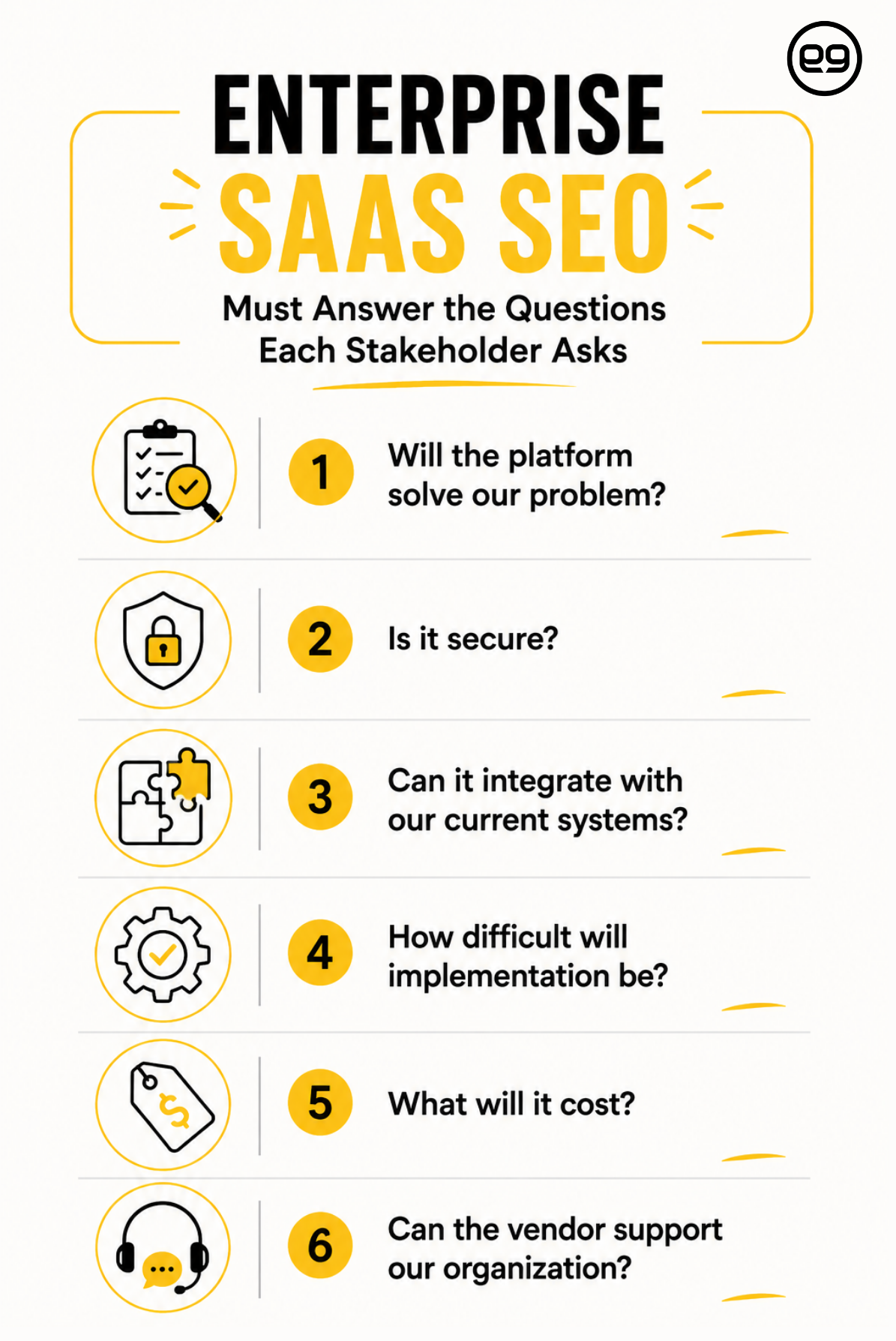
Enterprise SaaS SEO must answer the questions each stakeholder asks:
- Will the platform solve our problem?
- Is it secure?
- Can it integrate with our current systems?
- How difficult will implementation be?
- What will it cost?
- Can the vendor support our organization?
Each website page should remove another obstacle from the buying process. Think of it like an express train making only the stops passengers actually need. Clear content keeps the journey moving instead of sending prospects in circles.
2. Recurring Revenue Changes Everything
A local service provider may earn revenue from one appointment. An ecommerce company may profit from one transaction. SaaS companies can continue earning revenue every month or year that a customer remains subscribed.
That changes how the value of SEO should be calculated.
One high-ranking page may attract qualified prospects for years. Some visitors may convert immediately, while others may return several times before requesting a demo or beginning a trial.
Strong SaaS organic growth can create compounding returns through:
- Recurring subscriptions
- Annual renewals
- Plan upgrades
- Additional users
- Cross-selling opportunities
- Customer referrals
The real value of a ranking is not limited to the first time they fill out a form. It includes the customer’s potential lifetime value.
SEO is closer to a Monthly LIRR ticket than a single ticket. The initial acquisition opens the door, but the continuing relationship produces the larger return.
3. Buyers Educate Themselves
Modern B2B buyers complete much of their research before speaking with a salesperson. Google research found that B2B customers progressed nearly 60% of the way through the purchase decision before engaging a sales representative.5
It is vital that your website begin the sales conversation without your sales team in the room.
Effective B2B SaaS SEO gives buyers access to resources such as educational articles and feature explanations.
Every useful resource builds familiarity and reduces uncertainty.
A salesperson cannot stand beside every prospect while they research at 11 p.m. Your content can. It should anticipate their questions, explain complicated topics without unnecessary jargon, and show why your platform deserves consideration.
By the time a buyer contacts your company, your website should have already helped establish credibility and product fit.
Product-Led SEO: An SEO Opportunity
Many SaaS companies invest heavily in blogging while overlooking pages that show buyers how the product actually works.
Product-led SEO focuses on search content closely connected to the software. Instead of attracting readers with a broad topic and introducing the product as an afterthought, the content demonstrates how the platform solves the problem being researched.
B2B buyers spend a limited portion of their purchasing journey meeting with potential suppliers, increasing the importance of self-service information.7
Product-led content can include:
- Feature Explanations: Describe what each feature does and the specific problem it helps customers solve.
- Product Tutorials: Show users how to complete tasks, set up tools, or get more value from the platform.
- Workflow Examples: Demonstrate how the software fits into real business processes and day-to-day operations.
- Software Comparisons: Help buyers evaluate differences in features, pricing, usability, integrations, and overall fit.
- Interactive Templates: Give prospects a practical resource they can use while experiencing part of the product’s value.
- Integration Guides: Explain how the software connects with other platforms and supports existing systems or workflows.
A buyer should not have to visit three pages to understand your product. Connect the search question directly to the feature, workflow, or outcome that answers it.
Build SEO Content Around Your Product
Educational content can attract potential customers early in their research. Product content helps those visitors understand why your platform belongs on their shortlist.
Your SaaS content marketing plan should include pages that match the ways buyers investigate software:
- Feature Pages: Explain each major capability, the problem it addresses, and the practical benefit.
- Industry Pages: Show how the platform supports the needs, regulations, and workflows of specific markets.
- Integration Pages: Target people searching for software that connects with tools they already use.
- Comparison Pages: Provide balanced comparisons between products, plans, capabilities, or approaches.
- Alternative Pages: Reach prospects actively considering replacements for another platform.
The product should be woven naturally into the content. Show the reader how the software performs the task instead of publishing a generic article followed by a hard sales pitch.
SaaS Keyword Research: Think Like Your Buyer
One of the biggest mistakes SaaS companies make is selecting keywords based only on search volume. A popular phrase may attract thousands of visitors without producing a single qualified trial.
Effective SaaS keyword research considers what the search reveals about the buyer’s problem, awareness, and readiness to act.
A beginner’s keyword research process should include:
- Customer Problems: Identify the challenges that cause people to seek a solution.
- Product Categories: Research how buyers describe platforms like yours.
- Feature Searches: Target capabilities prospects need from the software.
- Industry Terms: Combine your product category with specific markets or professions.
- Comparison Keywords: Find searches involving competitors, alternatives, and “versus” terms.
- Integration Searches: Target connections between your platform and popular tools.
- Question Keywords: Address the concerns buyers raise during sales calls and demos.
- Intent Classification: Separate educational, commercial, and transactional searches.
- Conversion Potential: Prioritize terms likely to produce trials, demos, and revenue.
In NYC, the highest-volume route is not always the fastest route to Times Square. The same applies to your website. Choose keywords according to where qualified buyers are going.
Bottom-of-Funnel (BOFU) SEO
Top-of-funnel content introduces people to a problem or category. Bottom-of-funnel content reaches buyers who understand what they need and are evaluating specific solutions.
These searches may generate less traffic, but they often carry greater commercial intent. A strong SaaS SEO strategy balances broad educational visibility with pages designed to influence a purchasing decision.
BOFU searches often include phrases such as “best software for a specific need” and “product alternatives.”
A prospect reading a broad educational article may be months from buying. Someone comparing platforms or reviewing implementation requirements may be much closer.
Bottom-of-Funnel Content Every SaaS Company Should Create
B2B customers increasingly depend on digital content while researching and comparing vendors.8
Your SEO strategy should include:
- Industry Solutions: Explain how the platform addresses specialized challenges in healthcare, finance, manufacturing, nonprofits, education, or logistics.
- Feature Comparisons: Compare plans, capabilities, integrations, or workflows to help buyers select the right option.
- Migration Guides: Show prospects how they can move from a competing platform without losing data or disrupting operations.
- Implementation Pages: Explain onboarding, setup requirements, timelines, training, and the resources customers receive.
Migration and implementation content addresses two questions that can stall a software sale: “How difficult will switching be?” and “What happens after we sign?”
Answer those questions before the demo, and your sales team can spend more time discussing value instead of clearing avoidable roadblocks.
SaaS Site Architecture: Google Can’t Rank What It Can’t Understand.
As SaaS companies grow, a DIY website becomes harder to manage. Feature pages, integrations, documentation, blogs, pricing, support resources, and comparison content can quickly turn into a maze.
A clear SaaS SEO strategy gives every page a logical place. Visitors should understand where they are, what information is available, and where to go next.
Strong site architecture helps:
- Search engines discover important pages
- Buyers navigate complex product information
- Related pages reinforce one another
- Teams avoid duplicate or competing content
- High-value pages receive more internal links
Think of the New York subway map. The system is enormous, but the lines, stops, and connections give riders a structure they can follow. Your website needs the same kind of clarity.
Best practices for SaaS site architecture include the following.
1. Organize Content Into Clear Categories
Every major section of the website should serve a distinct purpose. Clear categories help buyers find relevant information without digging through unrelated pages.
A practical SEO for SaaS structure may separate content into:
- Features: Individual product capabilities
- Solutions: Problems the platform solves
- Industries: Markets and customer segments served
- Integrations: Tools and platforms that connect with the product
- Resources: Guides, reports, templates, and webinars
- Documentation: Technical and product instructions
- Blog: Educational and thought leadership content
- Support: Troubleshooting and customer assistance
Avoid placing the same content in several categories simply because it could fit in more than one place.
Each page should have a primary home and a clear role in the buyer journey.
2. Build Topic Clusters
A topic cluster begins with a broad pillar page and connects it to more focused supporting content.
For example, a project management software company could create a pillar page about improving team productivity and link to supporting pages covering:
- Task management
- Workflow automation
- Team collaboration
- Time tracking
- Resource planning
- Project reporting
- Software integrations
The supporting pages explore individual topics in greater depth, while the pillar page provides the complete overview.
This structure helps readers move from general information to specific questions without starting a new search. It also helps search engines recognize relationships among your pages.
Treat the pillar page like Grand Central’s arrival and departures screens. It should connect visitors to the right line without making them study the entire system first.
3. Keep Navigation Simple
Your most important pages should be reachable within a few clicks. If a buyer needs a map, a compass, and a customer support ticket to find pricing, the navigation has failed.
Simple navigation supports B2B SaaS SEO by making product information easier to discover and evaluate.
Prioritize links to:
- Core product pages
- Major features
- Industry solutions
- Pricing
- Integrations
- Resources
- Demo or trial pages
Avoid overloading the main menu with every page on the website. Use category pages and contextual internal links to guide visitors deeper.
SaaS websites can struggle with issues such as duplicate pages, weak content organization, and technical errors that limit organic visibility.9
A clean navigation system keeps valuable pages from becoming dead ends.
Technical SEO For SaaS: 5 Foundational Priorities
Technical SEO helps search engines access, interpret, and index your website. For SaaS companies with large content libraries, small technical problems can affect hundreds of pages at once.
Strong SaaS Technical SEO creates a stable foundation for product pages, documentation, integrations, and educational content.
Technical improvements do not replace useful content. They help ensure that useful content has a fair chance to appear in search. A brilliant campaign cannot perform if the tracking system, website speed, and page structure break under pressure.
1. Core Web Vitals
Core Web Vitals measure important parts of the user experience, including loading performance, responsiveness, and visual stability.10
Improving Core Web Vitals can make enterprise SaaS SEO pages easier to use, especially when websites contain complex scripts, interactive dashboards, videos, or product demonstrations.
Focus on:
- Loading speed: Reduce how long users wait for primary content.
- Responsiveness: Make interactions react quickly after a click or tap.
- Visual stability: Prevent buttons, text, and images from shifting unexpectedly.
A slow page creates friction before buyers have learned anything about the product.
Test key templates rather than checking only the homepage. Pricing, feature, comparison, and signup pages often matter more to revenue.
2. Crawlability
Crawlability refers to how easily search engines can discover and move through your website.
Strong SaaS organic growth depends on making high-value pages accessible through internal links and clean technical paths.
Review:
- Robots.txt Rules: Confirm that search engines are not accidentally blocked from crawling important pages.
- Internal Link Coverage: Make sure every valuable page receives links from other relevant areas of the website.
- Broken Links: Identify and fix links that lead users or search engines to missing pages.
- Redirect Chains: Shorten sequences of multiple redirects so users and search engines reach the final page faster.
- Orphan Pages: Find important pages that have no internal links pointing to them.
- JavaScript Rendering: Verify that search engines can properly load and understand content generated through JavaScript.
- Blocked Resources: Check that essential files, scripts, images, and stylesheets are accessible to search engines.
Technical issues can prevent SaaS content from being crawled or indexed correctly,11 which is why it’s important to have professionals available to fix them quickly.
3. XML Sitemaps
An XML sitemap provides search engines with a list of URLs you want them to discover. Sitemaps are especially useful for Saas SEO when a website regularly adds product resources, integrations, documentation, or blog content.
Keep sitemaps:
- Updated automatically
- Limited to indexable pages
- Free from redirects and errors
- Organized by content type when the site is large
- Submitted through Google Search Console
A sitemap does not guarantee that every URL will rank or even be indexed. It gives search engines a cleaner inventory of the pages available for review.
Remove outdated, duplicate, or blocked URLs so the file reflects the website you actually want Google to evaluate.
4. Structured Data
Structured data is code added behind the scenes of a webpage to help search engines understand what the content represents.
For example, a page may include a product name, price, review, or FAQ. A person can usually recognize those elements by reading the page, but search engines and AI search benefit from extra labels that explain exactly what each piece of information is.
That added context can help Google organize the page more accurately and determine whether it may qualify for enhanced search features.
Structured data does not improve the quality of the content itself, and it does not guarantee better rankings. It simply makes the page easier for search engines to interpret. Think of it like labeling every box before an office move. The labels do not change what is inside, but they make everything easier to identify, sort, and place correctly.
Only use structured data that matches the visible content on the page, and test it after major website updates to catch errors.
5. Duplicate Content
Duplicate content occurs when multiple URLs contain identical or substantially similar information.
This can happen when SaaS content marketing teams create overlapping feature pages, filtered URLs, regional versions, printer-friendly pages, or repeated product descriptions.
Common solutions include:
- Consolidating similar pages
- Using canonical tags (which let Google know what page you want to appear in search results) where appropriate
- Redirecting obsolete URLs
- Setting clear rules for filtered pages
- Writing original content for valuable variations
- Removing low-value duplicates from indexing
Not every repeated sentence creates a serious SEO problem. The larger concern is having several pages compete for the same purpose and keyword.
Internal Linking: Don’t Let Great Content Work Alone.
Internal links connect one page on your website to another. They help visitors continue their research while showing search engines how your content relates.
A strong SaaS keyword research plan should influence where those links point and how the anchor text describes each destination.
Useful internal linking routes include:
- Blogs to relevant feature pages
- Features to pricing information
- Pricing pages to demo requests
- Comparison pages to supporting features
- Documentation to related integrations
Google recommends using crawlable links and descriptive anchor text because they help search engines discover pages and understand what the linked content is about. Clear link text also gives users a better idea of where the link will take them before they click.2
Internal Linking Best Practices
Internal linking works best when every connection supports the reader’s next question.
Use these B2B SaaS SEO practices:
- Blogs to features: Connect educational problems with the product capabilities that solve them.
- Features to pricing: Help interested buyers understand cost and available plans.
- Pricing to demos: Give prospects a direct path to discuss fit, implementation, or enterprise needs.
- Comparison pages to feature pages: Support claims with deeper explanations of specific capabilities.
- Documentation to integrations: Help technical users understand how connected tools function.
- Use descriptive anchor text: Explain what readers will find after clicking.
- Avoid orphan pages: Make sure every important page receives at least one relevant internal link.
- Refresh older content: Add links from established pages whenever useful new resources are published.13
AI & The Future Of SaaS SEO
“AI may be a faster engine, but you still need an experienced driver. The companies that combine smart tools with real expertise will be the ones buyers and search engines trust.” — Conrad Strabone, Managing Partner & President | e9digital
Artificial intelligence is changing how buyers discover software, compare options, and research business problems. Search results may now include AI-generated summaries, while platforms such as ChatGPT and Gemini can answer questions without sending users directly to a traditional results page.
That does not make SaaS SEO irrelevant. It’s something you need to be aware of, or your site awareness could be impacted. Google continues to emphasize helpful, people-first content throughout its Search documentation.
AI-powered search systems still need reliable information to build useful answers. SaaS companies need content that clearly explains their products, demonstrates expertise, and provides information that other websites cannot easily duplicate.14
How to Prepare For AI Search
Preparing for AI search begins with publishing information that deserves to be referenced. Generic articles that repeat what every competitor has already said give search engines and AI platforms little reason to choose your company as a source.
A strong AI search strategy should include:
- Original Insights: Share lessons, observations, and expertise that come from your team’s real experience.
- Expert Opinions: Include informed perspectives from product leaders, developers, executives, and industry specialists.
- Proprietary Data: Publish surveys, platform data, benchmarks, and findings that are unavailable elsewhere.
- FAQs: Answer common questions clearly so search and AI systems can identify direct responses.
- Comparison Content: Help buyers understand meaningful differences between products, features, and approaches.
- Structured Information: Use clear headings, lists, tables, and concise explanations that are easy to interpret.
SaaS SEO Checklist
A successful SEO program requires coordination across content, technology, product marketing, and measurement.
Use this B2B SaaS SEO checklist to keep the most important priorities moving together:
- Define Your Ideal Customer: Identify the companies, teams, and decision-makers most likely to benefit from your platform.
- Research Search Intent: Understand what buyers want to learn or accomplish when entering each keyword.
- Build Topic Clusters: Organize broad pillar pages around supporting content that explores related questions.
- Create Feature Pages: Explain what each capability does and how it improves the customer’s work.
- Publish Comparison Pages: Help buyers evaluate products, plans, and approaches using clear, factual information.
- Optimize Technical SEO: Improve crawling, indexing, speed, mobile usability, and overall website performance.
- Strengthen Internal Linking: Connect related pages so users and search engines can navigate the content logically.
- Earn Authoritative Backlinks: Attract links by publishing research, tools, reports, and other useful resources.
- Track Conversions: Measure which pages and keywords generate trials, demos, signups, and qualified leads.
- Measure Recurring Revenue: Connect organic search activity to subscriptions, renewals, and customer lifetime value.
- Refresh Existing Content: Update important pages as products, markets, competitors, and buyer questions change.
- Prepare for AI Search: Publish credible, well-organized information that search engines and AI platforms can understand and reference.
SaaS SEO: Build Rankings. Build Trust. Build Revenue.
SaaS SEO works best when content, technical performance, product pages, and conversion strategy all support the same goal: attracting qualified buyers and turning search visibility into recurring revenue.
e9digital helps SaaS companies build SEO strategies that drive more than traffic. We combine website development, content, technical SEO, and conversion-focused design to generate demos, improve product signups, lower acquisition costs, and support long-term growth. Let’s turn your search presence into a dependable sales channel.
SaaS SEO Frequently Asked Questions
How Long Does SaaS SEO Take?
Most SaaS companies begin seeing measurable improvements within several months, although meaningful organic growth usually requires consistent work over a longer period. Results depend on website authority, competition, technical condition, content quality, and available resources. SEO works more like a marathon than a quick sprint.
What Content Performs Best for SaaS Companies?
The strongest content depends on buyer intent, but feature pages, comparison pages, integration pages, industry solutions, case studies, educational articles, and documentation often perform well. The best strategy combines informative resources with product-focused pages that help prospects understand the platform and move closer to a purchase.
Is SEO Better Than Paid Advertising?
SEO and paid advertising serve different purposes and usually perform best together. Paid campaigns can generate immediate visibility, while SEO builds sustainable traffic and authority over time. A balanced strategy allows SaaS companies to capture demand now while reducing long-term dependence on paying for every website visit.
How Often Should SaaS Content Be Updated?
Important SaaS content should be reviewed at least once a year and updated sooner when products, pricing, competitors, statistics, or search behavior change. High-traffic pages, product comparisons, feature content, and declining articles deserve closer attention because outdated information can weaken trust, rankings, and conversion performance.
How Much Does SaaS SEO Cost?
SaaS SEO costs vary based on website size, competition, technical complexity, content needs, and the level of ongoing support required. A smaller company may begin with a focused strategy, while a larger platform may need continuous technical optimization, content development, link building, and detailed revenue tracking.
Should a New SaaS Company Invest in SEO?
Yes. Starting early helps a new SaaS company build a strong site structure, target the right keywords, and create useful product content before poor decisions become expensive to fix. SEO may take time to gain traction, but early investment allows visibility and authority to grow alongside the business.
Resources
- https://blog.hubspot.com/marketing/seo-stats
- https://developers.google.com/search/docs/fundamentals/creating-helpful-content
- https://liveramp.com/resources/cimm-effective-practices-for-b2b-marketing-measurement-eb-registration
- https://www.marketermilk.com/blog/saas-seo
- https://www.thinkwithgoogle.com/marketing-strategies/b2b/
- https://seosherpa.com/saas-seo/
- https://www.gartner.com/en/sales/insights/b2b-buying-journey
- https://www.gartner.com/en/sales/insights/b2b-buying-journey
- https://www.seoptimer.com/blog/saas-seo/
- https://web.dev/articles/vitals
- https://seosherpa.com/saas-seo/
- https://developers.google.com/search/docs/crawling-indexing/links-crawlable
- https://backlinko.com/saas-seo
- https://developers.google.com/search/docs/fundamentals/creating-helpful-content
The post SaaS SEO: The Complete Guide to Growing Organic Revenue appeared first on e9digital.