Why Email Still Matters for Small Businesses
Marketing trends can feel like speed dating. One flashy platform shows up, makes big promises, then gets replaced by the next one before you have even learned how to log in. However, one tried and trusted strategy breaks this pattern: email. The average email marketing ROI is around $36 to $42 for every $1 spent.
Small business email marketing works because consumers want to hear from you. About 60% of consumers say that email is their preferred way to hear from brands.
That combination is what makes email such a strong play. It’s cost-effective, direct, and far less dependent on the mood swings of social algorithms. Our team uses email drip campaigns to keep in touch with potential customers who have previously shown interest in our services, and to share insights with our current ones. At the same time, it reminds them we are always available to help with their website design and marketing needs.
What Is Small Business Email Marketing?
“If your emails are just you talking about yourself, that’s background noise. The goal is to hand people a useful nugget, not another piece of digital junk mail they delete immediately.” — Conrad Strabone, Managing Partner & President | e9digital
Small business email marketing is the practice of sending targeted, permission-based emails to prospects and customers to drive sales, repeat business, and long-term relationships. In plain English, it’s how a small business stays in touch with people who have already raised their hand and said, “Yes, keep me in the loop.”
That permission is critical: to send marketing emails, people must opt in. Then, you send them something useful, and over time that trust turns into clicks, calls, purchases, and referrals.
Here are the basics of small business email marketing:
- A direct line to your customers’ inbox: Subscribers opt in to hear from you, so email gives you direct access to an audience you actually own.
- Built around content: Good email marketing starts with a quality list, useful content, and clear CTAs that drive clicks and sales.
- More than newsletters: It can include welcome emails, promotions, seasonal campaigns, event announcements, nurture flows, and re-engagement emails.
That last point matters because email is bigger than the monthly newsletter many businesses picture. It’s a toolbox, not a single hammer. A welcome series introduces your brand. A promotion drives sales. A nurture sequence keeps leads warm. A re-engagement email brings lapsed customers back into the fold.
It’s important to remember that email is a credibility channel. You win by showing up with relevance, clarity, and respect.
Why Is Email Marketing Important for Your Small Business?
Email marketing is important for small businesses because it gives you a direct, affordable, high-return way to reach customers and keep your business in front of people who are already interested. Approximately 44% of small businesses say it’s their most effective marketing channel.
But why email specifically? Social media can help with visibility, but it’s rented space and you are playing by their rules. Email gives you an owned audience. When you build your list the right way, you are creating an asset your business controls instead of one a platform can limit whenever it changes the rules (just ask all the frustrated Instagram creators when the app changed the image post size ratio).
Plus, 99% of customers check their inbox at least once a day, which turns into a 2.4–2.8% conversion rate (people who take an action from an email, such as make a purchase or book a call). This makes it one of the most effective channels at turning clicks into sales or leads.
The Core Components of a Small Business Email Strategy
A good email strategy is a lot like a recipe. You can’t just wing it and hope for the best. You need the right ingredients, the right tools, and a process that does not fall apart the second things get busy.
The email marketing for small businesses recipe requires five essential ingredients:
- A permission-based list
- The right email marketing software
- A smart segmentation strategy
- Useful content and clean design
- A consistent cadence with automation where it counts
1. Permission-Based Email List
Plenty of businesses still treat email lists like a junk drawer. They collect random contacts, upload them in bulk, and then act surprised when engagement is weak and spam complaints pile up.
To get a permission-based list, you have to ask people if they want to subscribe via website pop-ups, embedded forms, social media links, and checkout checkboxes. It’s important that they have the option to unsubscribe at any time.
A permission-based list does a few important things:
- Protects your brand reputation
- Improves open and click potential
- Reduces the risk of spam complaints
- Keeps your marketing aligned with legal requirements like CAN-SPAM
Your list should feel more like a guest list than a fishing net. Smaller and intentional usually beats bigger and messy.
2. Email Marketing Software & Tools
Trying to run campaigns through Gmail is like showing up to build a house with a butter knife. You have to add each email manually and there are few features to design how the email looks.
You need email marketing tools that can actually support the work, which includes managing subscribers, applying templates, tracking performance, automating sends, and handling unsubscribes properly.
What’s most important is to choose a platform your team will use consistently. A solid email platform should help you:
- Organize your list: Your contact database or audience
- Build campaigns efficiently: Deliver marketing emails to a group of contacts
- Track opens, clicks, and conversions: Measure who opened, clicked, and completed a desired action
- Set up automations: Create emails or workflows that send automatically based on timing or behavior
- Stay compliant: Follow email marketing laws and privacy regulations
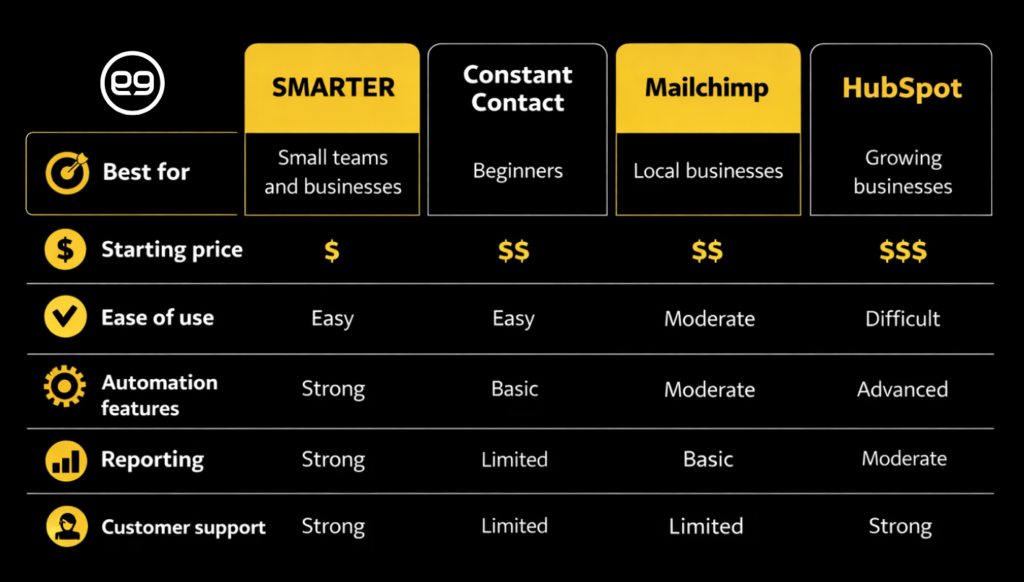
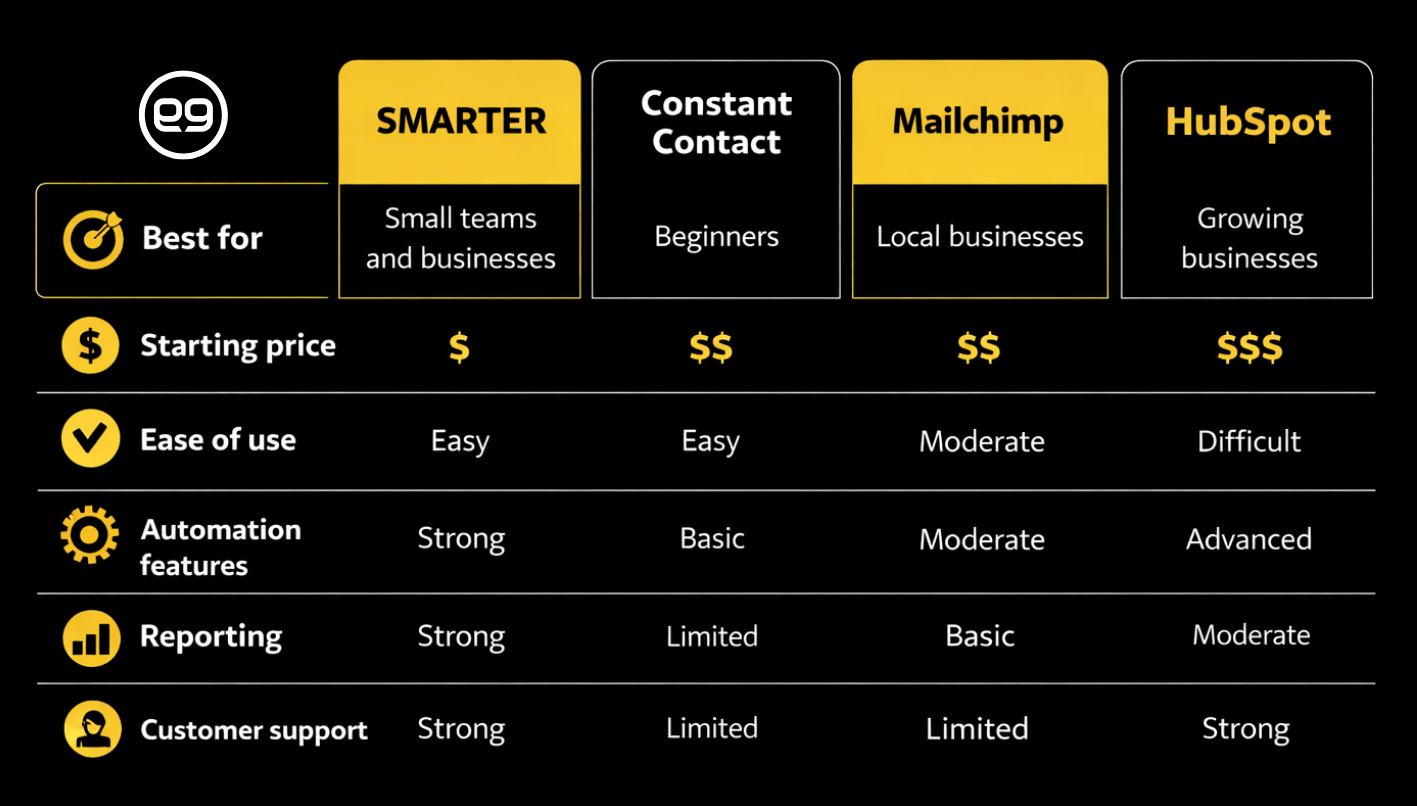
Some of the best email marketing software options for small businesses include SMARTER, Mailchimp, Constant Contact, and HubSpot.
Small Business Email Marketing Software Comparison Chart
3. Strategy & Segmentation
One of the fastest ways to make your email marketing underperform is to send the same message to everyone. New leads, repeat buyers, event attendees, and cold contacts are not all standing at the same point in the journey. To optimize email marketing for small businesses, focus on segmentation.
Segmentation is the process of dividing an email subscriber list into targeted groups based on specific criteria to send more relevant messages.
You might segment based on:
- Customer type
- Location
- Purchase behavior
- Webinar or event attendance
- Lifecycle stage
- Previous clicks or engagement
When people get emails that match what they actually care about, results usually improve. Segmentation helps your team say the right thing to the right person at the right time.
4. Content & Design
“Small business marketing works best when it feels like a good conversation, not a doctor’s office intake form. People want to work with businesses that are clear, approachable, and easy to understand.” — Conrad Strabone, Managing Partner & President | e9digital
A lot of business emails fail for the same reason bad sales pitches fail. They lead with “look at us” instead of “here is something useful for you.” Good email content gives readers a reason to stay engaged before asking them to take action.
Strong content often includes:
- Helpful tips: Actionable advice that solves a problem, answers a common question, or helps your audience make a smarter decision.
- Relevant updates: News, changes, or announcements that keep subscribers informed about your business, services, or industry.
- Short stories or examples: Quick illustrations that add context, show real-world impact, and make your message easier to relate to.
- Timely offers: Promotions or opportunities tied to a season, deadline, launch, or immediate customer need.
- Clear next steps: A simple, specific call to action that tells readers exactly where to click, book, buy, or learn more.
Design matters too, especially on mobile. Since approximately 60% of emails are opened on phones, layout has to be easy to scan and easy to tap. Good design usually includes clear headings, short paragraphs, clickable buttons, and enough white space to keep the message readable.
5. Cadence & Automation
Consistency tends to beat intensity. Most small businesses get better results from a dependable rhythm than from random bursts followed by radio silence. A cadence of one to four emails per month is often enough to stay visible without automatically getting put in the trash.
A healthy cadence helps you stay top of mind, support promotions and announcements, and keep customers engaged between purchases.
Automation is where small teams can gain real leverage. This allows campaigns to keep working in the background while your team handles everything else on the to-do list. That matters because many SMBs have very limited time for marketing each day.
Useful automated drip campaigns (where software sends scheduled emails after a decided action) often include:
- Welcome sequences: A short series of emails that introduces your brand, sets expectations, and guides new subscribers toward a first action.
- Post-purchase follow-ups: Emails sent after a sale to confirm the experience, build trust, and encourage repeat business or reviews.
- Abandoned cart reminders: Automated messages that bring shoppers back to complete a purchase they started but did not finish.
- Event reminders: Emails that keep registrants informed and increase attendance with timely details before the event.
- Re-engagement emails: Campaigns designed to reconnect with inactive subscribers and bring them back into the conversation.
Email Benchmarks: What “Good” Looks Like for Small Businesses
Benchmarks matter because without them, email performance can feel like throwing darts in a dark room. You may hear a thud, but that does not mean you hit the board. A few practical benchmarks can help you understand whether your program is healthy or needs work.
Some useful metrics for email marketing for small businesses include:
- Open rates: Many reports place averages around 20% to 25%, while well-maintained lists can reach the mid-30s or low-40s.
- Click rates: The average click rate (those who click a link in your email) is around 2.09%, with click-to-open rates (those who opened your email and then clicked a link) around 6.81%.
- Conversion rates: Most emails convert at around 2.4% to 2.8%.
- Bounce rates: Under 2% is generally considered healthy.
- Unsubscribe rates: Around 0.2% to 0.5% is usually a solid range.
Before treating these benchmarks like gospel, there are some asterisks. Your industry affects your performance—nonprofits have a much higher open rate at 40% than ecommerce companies do at 30%. The quality of your audience matters more than the size of your list. You don’t need people clogging up your list who aren’t interested in your goods or services.
How to Start Email Marketing as a Small Business
Getting started with email marketing can feel a little like trying to build Ikea furniture without the instructions. It might seem okay at first, but then your bookshelf randomly breaks in six months because you switched the screws and the nails.
The good news is that email marketing is much simpler than it looks when you break it into a few clear steps.
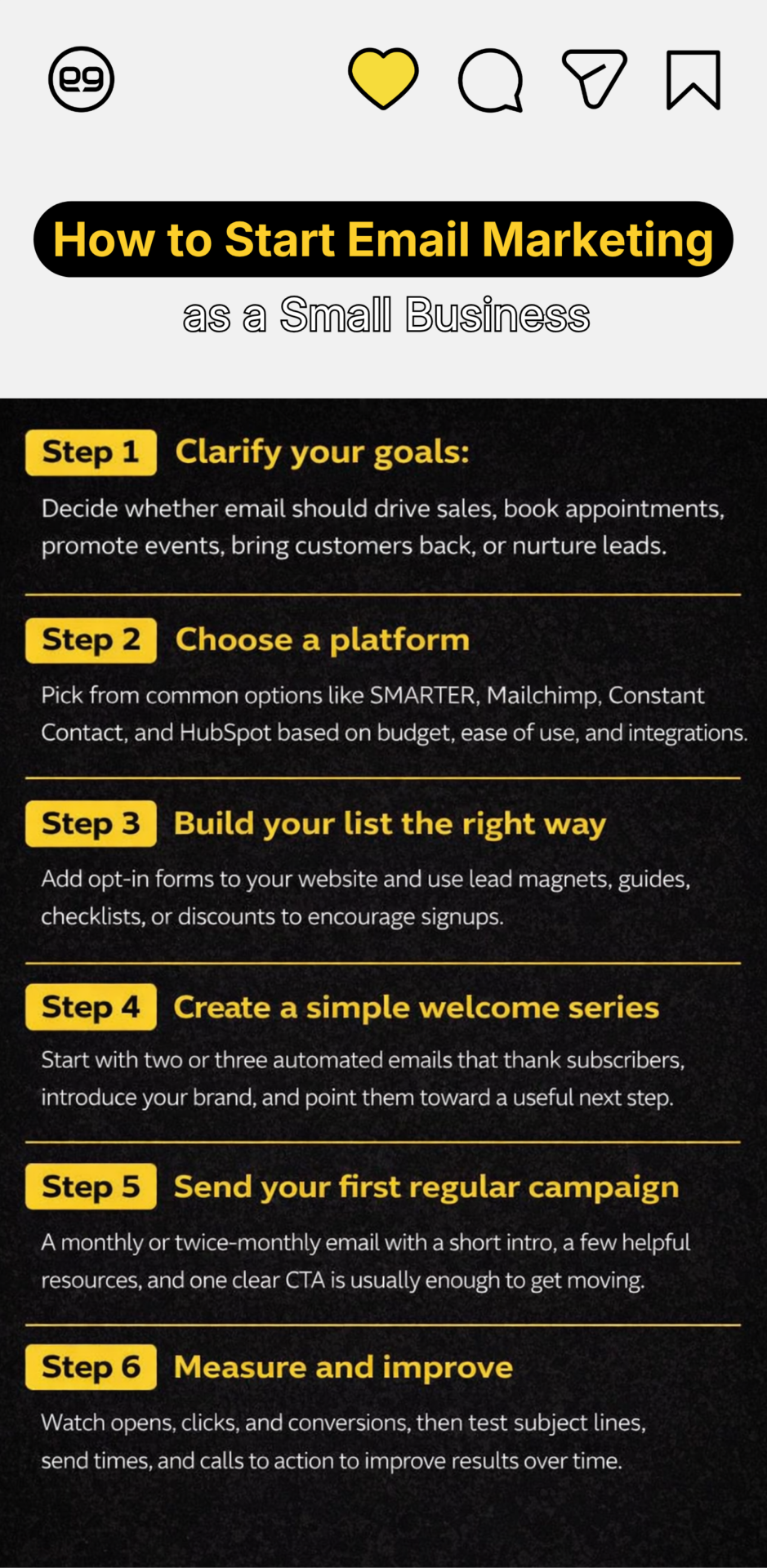
Here are a few small business email marketing tips to get you started:
Step 1: Clarify your goals: Decide whether email should drive sales, book appointments, promote events, bring customers back, or nurture leads.
Step 2: Choose a platform: Pick from common options like SMARTER, Mailchimp, Constant Contact, and HubSpot based on budget, ease of use, and integrations.
Step 3: Build your list the right way: Add opt-in forms to your website and use lead magnets, guides, checklists, or discounts to encourage signups.
Step 4: Create a simple welcome series: Start with two or three automated emails that thank subscribers, introduce your brand, and point them toward a useful next step.
Step 5: Send your first regular campaign: A monthly or twice-monthly email with a short intro, a few helpful resources, and one clear CTA is usually enough to get moving.
Step 6: Measure and improve: Watch opens, clicks, and conversions, then test subject lines, send times, and calls to action to improve results over time.
The key is to start with something manageable. A lot of small businesses stall because they are trying to build the perfect program before sending the first email. That is like refusing to learn to drive until you can build the engine. Start simple, then refine.
Trends in Small Business Email Marketing
Email is still one of the most dependable channels in marketing, but that does not mean it’s not evolving. AI marketing tools and automation give marketers the power tools they need to get a job done faster.
A few trends are shaping where email is headed:
- Automation is becoming standard: Many SMBs now use drip campaigns and automated workflows to handle welcome emails, nurture sequences, reminders, and follow-ups.
- AI is helping with speed and personalization: Businesses use AI for subject line testing, audience segmentation, and content creation—but need humans to catch errors.
- Small teams are using email to do more with less: That matters when many SMBs have less than an hour a day to spend on marketing.
- Relevance is becoming the real competitive edge: Better timing and better targeting usually beat sending more emails.
This is where AI can be useful, but only when it’s used with some judgment. AI is a great sous-chef. It can prep ingredients, save time, and keep things moving. It should not be left alone to run the whole kitchen. Small businesses still need humans to provide strategy, voice, and clear goals behind the tools.
Turn Your Email Into a Revenue Engine With e9digital
“Marketing is not your cable bill. It’s an investment portfolio. The question is not whether it costs money. The question is whether it’s producing a return that makes the investment look smart.” — Conrad Strabone, Managing Partner & President | e9digital
A lot of agencies talk about email like it’s a side dish. Helpful, sure, but not the main event. At e9digital, email is part of the larger ecosystem that helps your marketing sell while you are busy doing the actual work of running a business. That matters because good email does not live in isolation. It works best when it’s connected to your website, your content, your SEO, and the rest of your growth strategy.
What makes e9digital different is simple: we have skin in the game. The same thinking we bring to our clients is the thinking we use ourselves. We care about building marketing systems that are clear, credible, and built to last.
Ready to up your email marketing game, or even just send one email? Schedule a call with our team today to learn how we can help.
Frequently Asked Questions
How Does Email Marketing Help Your Small Business?
Email marketing helps your small business by giving you a reliable way to stay connected with leads and customers after that first interaction.
Think of it as the follow-through channel. Someone visits your site, downloads a guide, makes a purchase, or asks about your services. Email helps you keep that relationship moving instead of letting it go cold. It gives you a simple way to educate prospects, answer common questions, share updates, and guide people toward the next step when they are ready.
For small businesses, that matters because most customers do not act the first time they hear from you. Email helps you stay relevant during the gap between interest and action.
What Are The Benefits Of Email Marketing For Small Businesses?
The benefits of email marketing for small businesses include stronger customer relationships, better consistency in communication, and a more organized path from interest to conversion.
A well-run email program helps you:
- Build familiarity over time
- Support the customer journey with timely messages
- Keep your marketing active between campaigns
- Create a better experience with targeted communication
- Turn one-time interactions into ongoing engagement
In simple terms, email helps small businesses stay connected without having to reinvent the wheel every time they want to reach their audience.
The post Small Business Email Marketing: What You Need to Know appeared first on e9digital.